
15 Best Running Backs in NFL History, Ranked
Summary
- Statistics often only tell part of the story when determining the best running backs in NFL history.
- Prioritizing performance relative to era and how players would fare with today’s advancements in medicine and technology is a key factor when ranking players at any position.
- Jim Brown, Walter Payton, Barry Sanders, Emmitt Smith, and LaDainian Tomlinson comprise the top five backs in league history.
Since the NFL’s inception more than a century ago, there have been countless gifted running backs to grace the gridiron. From Red Grange to Derrick Henry, the position is as storied as any in the game. However, simply acknowledging great players isn’t enough. Many fans have this visceral urge to compare and contrast great players to determine who is the best of them all.
Ranking players across generations is an imperfect science, but it’s important to maintain consistent criteria. Firstly, these players are being ranked based on their performance relative to their era. Of course, the athletes of today are far better than those who took the field 50 years ago, but it’s important to account for the various advantages of modern medicine and technology.
How would Jim Brown play if he had access to today’s training methods? How well would Emmitt Smith’s body have held up behind a lesser offensive line in the leather helmet days?
These questions are intriguing, but they are merely hypotheticals that aren’t falsifiable, making them of little value to this conversation. Due to the position’s shorter shelf life, there will be a greater emphasis placed on prime performance. Those who sustained high-level play for longer will still be rewarded, but longevity must act as a supplement for peak performance, not a substitute.
A running back’s primary objective is to take handoffs from the quarterback, but that’s only part of the job description. While rushing prowess is still the main criterion, those who provide value as pass catchers as well as in pass protection get a boost.
Team success takes a bit of a backseat, as there’s only so much one player can do. Many of the players on this list have one or no championships, but this is a greater reflection of what was around them rather than their individual ability. Surrounding talent matters and will be factored into every running back’s ranking. Without further ado, here are the 15 greatest running backs of all time.
1
Jim Brown
Brown stands alone as the greatest running back in league history
It was stated in the introduction that these running backs would be judged relative to era. Following that rubric, it’s difficult to give the top spot to anyone other than the late Jim Brown. With Brown’s all-encompassing resume and wire-to-wire dominance, one could argue he’s the greatest football player ever, regardless of position.
| Jim Brown Career Stats | ||
|---|---|---|
| Stat | Regular season | Playoffs |
| Games | 118 | 4 |
| Rushing Yards | 12,312 | 241 |
| Yards Per Carry | 5.2 | 3.7 |
| Rushing Touchdowns | 106 | 1 |
| Receptions | 262 | 8 |
| Receiving Yards | 2,499 | 99 |
| Receiving Touchdowns | 20 | 0 |
| Fumbles | 57 | 0 |
As an athlete, Brown, who spent his entire career with the Cleveland Browns, was truly ahead of his time. At 6’2″, 232 pounds, he would be considered a massive running back in today’s game, let alone in the 1960s. Brown dominated throughout the entirety of his career, leading the league in rushing in eight of his nine years. He was awarded NFL MVP by the AP or UPI (United Press International) in four seasons, including his rookie year, was named a Pro Bowler nine times and a first-team All-Pro on eight occasions.
It’s worth noting that Brown’s career took place before the adoption of the 16 and 17-game regular seasons. After Brown’s fourth year, the league moved from 12 games to 14, but the shorter seasons stopped him from having the all-time or per-year numbers he was capable of.
Had he played during a time with longer seasons and more rules to protect ball carriers, Brown likely would’ve finished his career with multiple unbreakable records.
How many professional athletes from 60 years ago would be able to compete if they were in their prime today? There’s no definitive answer, but you’d have to imagine it would be a brief list. Perhaps Wilt Chamberlain or Sandy Koufax would be the strongest bets. Brown is one of those anomalies.
His athletic profile wouldn’t be far off from the average running back today. He achieved a level of dominance that has yet to be matched. Nearly 60 years after his final season, it’s safe to say there will never be another Jim Brown.
2
Walter Payton
Payton’s complete game made him the best running back of the Super Bowl era

Nearly 25 years after his death, Walter Payton’s legacy transcends the game of football. Thanks to the Walter Payton Man of the Year Award, given each year to an NFL player for his off-field work, Payton’s name illustrates what it means to be more than an athlete.
| Walter Payton Career Stats | ||
|---|---|---|
| Stat | Regular season | Playoffs |
| Games | 190 | 9 |
| Rushing Yards | 16,726 | 632 |
| Yards Per Carry | 4.4 | 3.5 |
| Rushing Touchdowns | 110 | 2 |
| Receptions | 492 | 22 |
| Receiving Yards | 4,538 | 178 |
| Receiving Touchdowns | 15 | 0 |
| Fumbles | 86 | 4 |
While Payton’s character and spirit make him a lionized player all these years later, none of that factored into his placement on this list. Payton was a true workhorse, leading the league in carries for four consecutive seasons and notching 300 carries in 10 of them.
Payton’s claim for the top spot is two-fold. He possessed one of the most complete skill sets the position has ever seen. In addition to being a great pure runner, he provided value as a pass catcher and in pass protection.
His prime also spanned over 10 years. Payton burst onto the scene in the 1976 season and was still the Chicago Bears’ best offensive player on the legendary 1985 team and was the runner-up in MVP voting. It wasn’t until his age-34 season that he showed signs of decline.
Had the gap between the next entry on the list and Payton’s rushing ability been greater, this wouldn’t have been enough. But given how close the two are from an accolades standpoint, Payton’s more complete game and longer career give him the slight edge for the second spot on this list.
3
Barry Sanders
Sanders was a human highlight reel
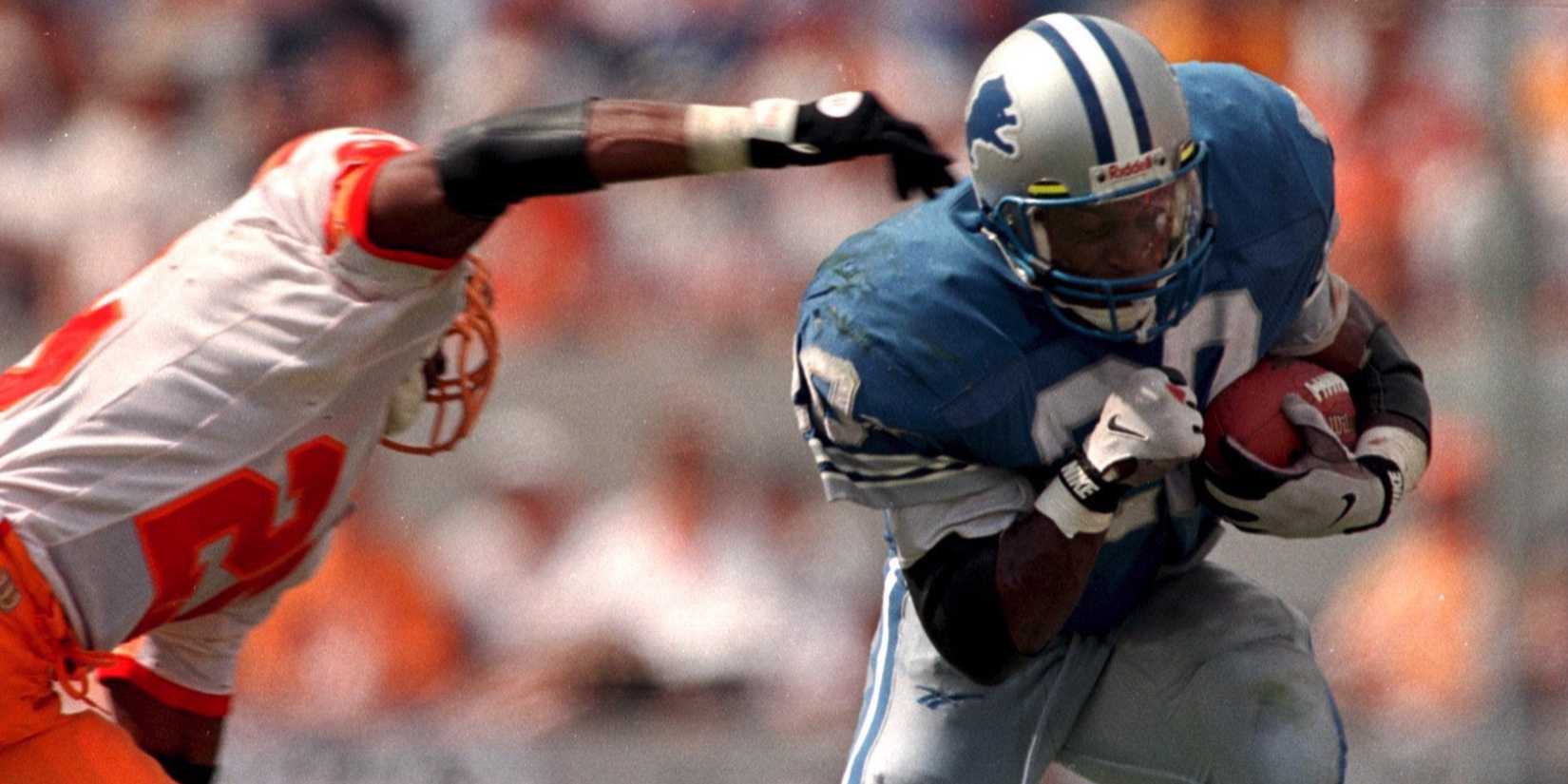
Sports, especially those as punishing as American football, can be brutal and violent. Fans tune in to see the thrill of grown men crashing into one another. However, Barry Sanders’ game wasn’t reminiscent of the typical bulldozing back.
He played the game of football like a musician plays an instrument; it was precise, detailed, and beautiful. Football at its best can be an art, and there has never been a better artist than Sanders.
| Barry Sanders Career Stats | ||
|---|---|---|
| Stat | Regular season | Playoffs |
| Games | 153 | 6 |
| Rushing Yards | 15,269 | 386 |
| Yards Per Carry | 5.0 | 4.2 |
| Rushing Touchdowns | 99 | 1 |
| Receptions | 352 | 21 |
| Receiving Yards | 2,921 | 111 |
| Receiving Touchdowns | 10 | 3 |
| Fumbles | 41 | 1 |
Sanders was nearly impossible to bring down on first contact. His low center of gravity and footwork allowed him to weave around defenders with ease. Sanders racked up serious hardware, winning three Offensive Player of the Year awards and a rare co-NFL MVP in 1997.
Sanders was a departure from the typical downhill rusher. He looked to dance and create his own holes, sometimes to his own detriment. This play style, though, allowed Sanders to be a one-man offense. With the ball in his hands, he could make magic happen.
For those lucky enough to watch Sanders, his career is often discussed with a modicum of sorrow, for he walked away with a lot of juice left in the tank. With the Detroit Lions failing to surround Sanders with the necessary talent to contend, he lost his hunger and retired after his 10th season.
In a parallel universe where Sanders didn’t retire at age 30 following the 1998 season and continued his illustrious career, he is likely the unanimous greatest back of all time. In this universe, however, he misses out and settles for third.
4
Emmitt Smith
Smith’s illustrious career led to multiple records
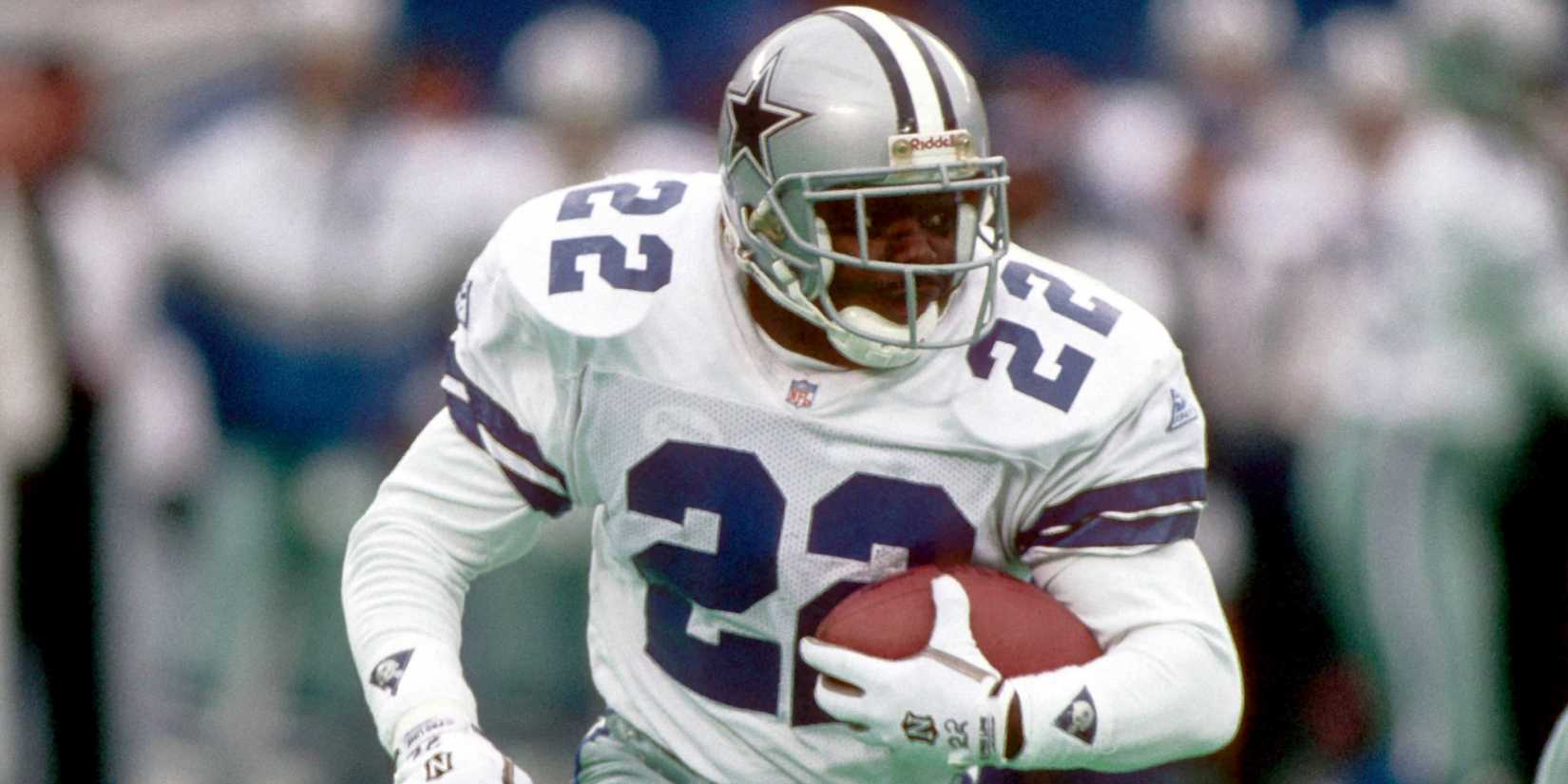
Emmitt Smith’s ranking could go a few different ways. On one hand, he’s the league’s all-time leading rusher, a record that looks more unbreakable by the year. Conversely, he was blessed with arguably the best situation of any player on this list with the Dallas Cowboys.
| Emmitt Smith Career Stats | ||
|---|---|---|
| Stat | Regular season | Playoffs |
| Games | 226 | 17 |
| Rushing Yards | 18,355 | 1,586 |
| Yards Per Carry | 4.2 | 4.5 |
| Rushing Touchdowns | 164 | 19 |
| Receptions | 545 | 46 |
| Receiving Yards | 3,224 | 342 |
| Receiving Touchdowns | 11 | 2 |
| Fumbles | 61 | 4 |
Isolating Smith’s performance is easier said than done. No one is suggesting that any average running back could become the all-time leading rusher behind that offensive line, but it’s hard to deny Smith was a beneficiary of his surrounding talent.
Smith, Troy Aikman, Michael Irvin, and an offensive line filled with Pro Bowlers and All-Pros gave opposing defenses all they could handle and then some.
Smith’s consistency is unrivaled. He recorded 11 straight 1000-yard seasons and had at least 900 in 14 of his 15 years. Yes, much of this consistency can be attributed to his situation, but Smith deserves some credit of his own for his awareness as a runner. He knew when to lower his shoulder and absorb contact, but he also had a knack for avoiding unnecessary hits.
As far as career statistics and accomplishments go, Smith is the undisputed No. 1. It would be easier to name what Smith didn’t win during his career than what he did. Three Super Bowls, a Super Bowl and regular season MVP, and an Offensive Rookie of the Year make for quite the resume.
At this stage of the list, the margins get razor-thin. Who goes where comes down to the smallest discrepancies. For Smith, the star-studded offensive line makes his career success slightly less impressive than that of the remaining players.
5
LaDainian Tomlinson
Tomlinson’s greatness shouldn’t go overlooked
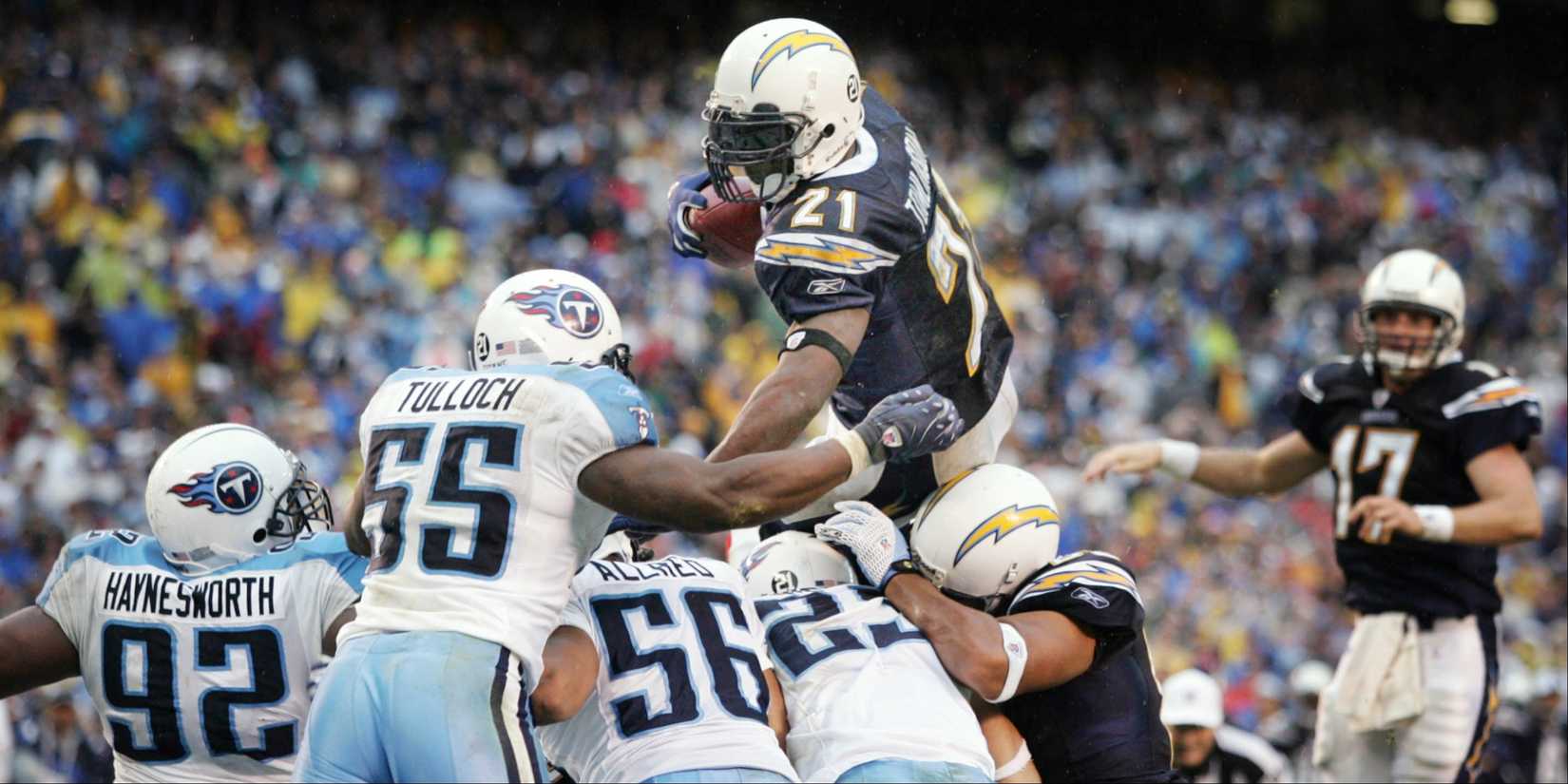
The then-San Diego Chargers’ lightning bolt was a fitting emblem to describe LaDainian Tomlinson’s game. He was explosive and powerful, and on the field, he was a force of nature.
Tomlinson made five Pro Bowls and five All-Pro teams, as well as winning league MVP in 2006. His whopping 2,323 yards from scrimmage and 31 total touchdowns make for one of the greatest single seasons in league history, regardless of position.
| LaDainian Tomlinson Career Stats | ||
|---|---|---|
| Stat | Regular season | Playoffs |
| Games | 170 | 10 |
| Rushing Yards | 13,684 | 468 |
| Yards Per Carry | 4.3 | 3.6 |
| Rushing Touchdowns | 145 | 6 |
| Receptions | 624 | 25 |
| Receiving Yards | 4,772 | 176 |
| Receiving Touchdowns | 17 | 1 |
| Fumbles | 31 | 2 |
Tomlinson’s legacy has suffered to no fault of his own. Emmitt Smith played for America’s Team and won multiple Super Bowls, Barry Sanders was flashy and exhilarating to watch, and Walter Payton was a part of the 1985 Bears and has an award named after him.
Tomlinson was an incredible, breathtaking talent, but he wasn’t quite as iconic. His teams seldom did damage in the postseason, and his style of play, while effective, wasn’t flashy.
Even if his name doesn’t hold the same weight as others, Tomlinson’s status as one of the greatest backs ever shouldn’t be in dispute. He was one of the best offensive weapons of this millennium, and some of his records will likely stand for many years.
6
Marshall Faulk
Faulk’s versatility headlined the Greatest Show on Turf
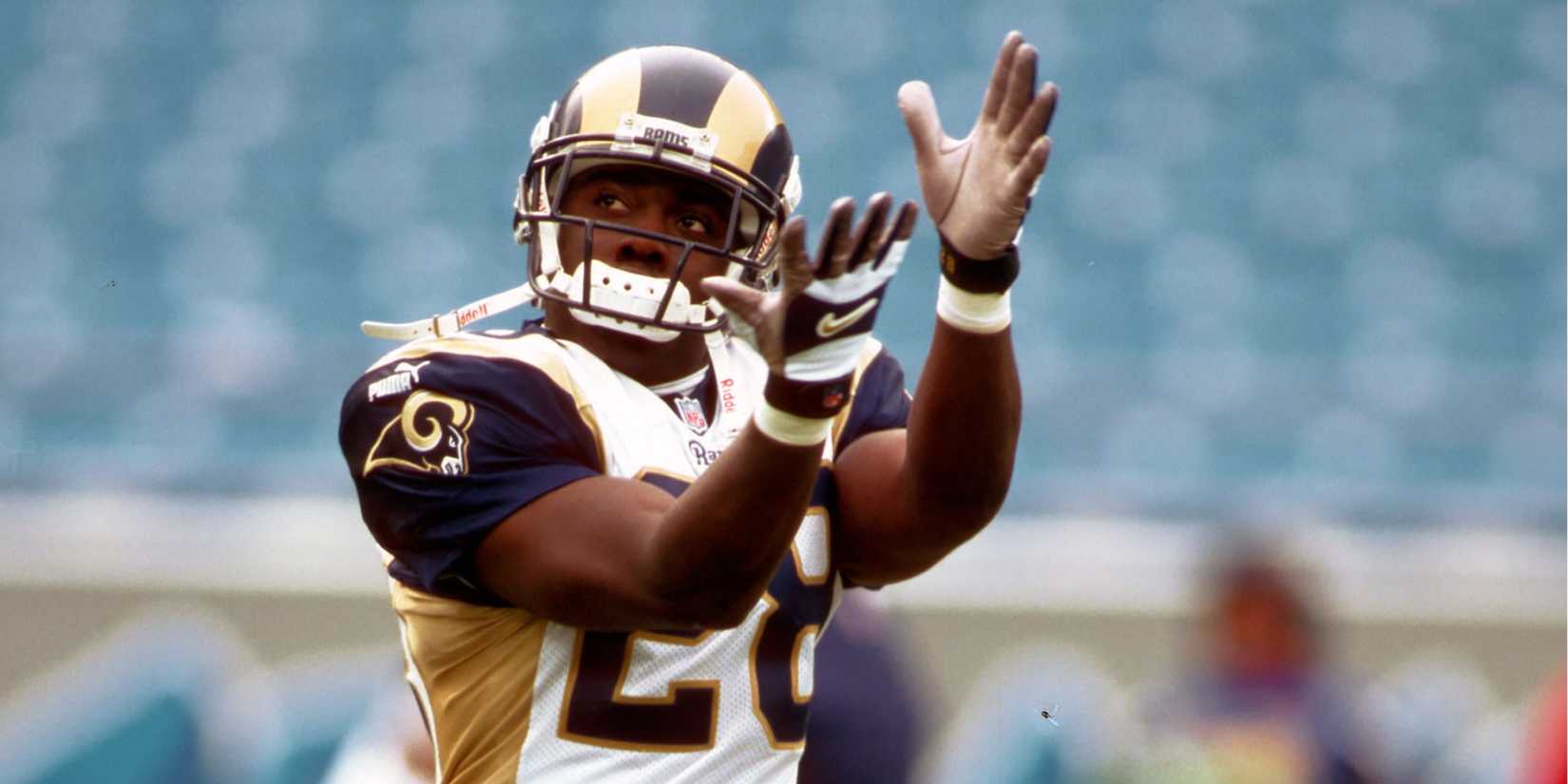
Marshall Faulk began his career with the Indianapolis Colts but truly became one of the all-time greats with the then-St. Louis Rams. In St. Louis, Faulk would unlock his full potential, winning three consecutive Offensive Player of the Year awards and the 2000 MVP.
| Marshall Faulk Career Stats | ||
|---|---|---|
| Stat | Regular season | Playoffs |
| Games | 176 | 12 |
| Rushing Yards | 12,279 | 602 |
| Yards Per Carry | 4.3 | 3.6 |
| Rushing Touchdowns | 100 | 6 |
| Receptions | 767 | 52 |
| Receiving Yards | 6,875 | 519 |
| Receiving Touchdowns | 36 | 2 |
| Fumbles | 36 | 0 |
Faulk’s game was defined by efficiency and versatility. Though he never eclipsed 1,400 rushing yards in a season, he led the league in yards per carry in all three of his Offensive Player of the Year-winning seasons. He didn’t get the same usage in the run game as other backs, but he didn’t need to.
This isn’t to suggest Faulk couldn’t be a workhorse; it was just in a different way. Faulk played a massive role in the passing game, even surpassing 1,000 receiving yards in his MVP season. In a way, Faulk helped redefine the running back position.
As the league was beginning to embrace the air raid offense, old-school running backs were in danger of going out of style. With a Hall of Fame quarterback like Kurt Warner, playing through the run game just wasn’t sensible. Faulk took on a greater role as a pass catcher and flourished, allowing him to continue being a focal point of the offense.
The idea that great running back play doesn’t translate to postseason success has gained traction in recent years, with fewer teams looking to build around the position. Faulk is the last running back to win a Super Bowl the same year as being named a First-Team All-Pro. With each passing year, fans become more appreciative of his game and ability to elevate his team.
7
Adrian Peterson
Peterson was the best running back of his generation
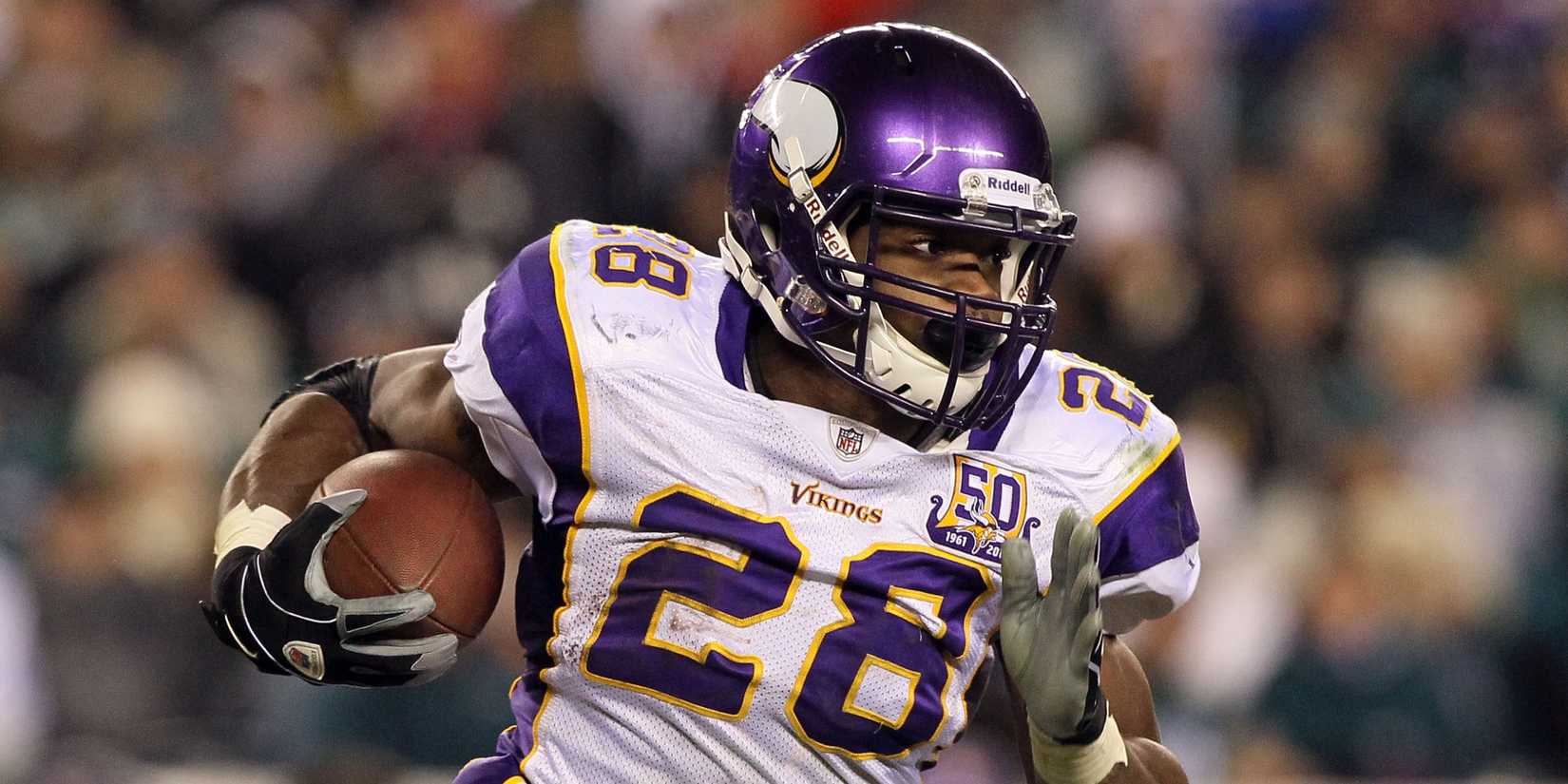
Peterson may have been among the last of a dying breed. The league is churning out fewer workhorse running backs by the year, and with Peterson’s legendary 2012 season marking the last time a running back won the MVP, it’s fair to question if this is the new norm for the position.
| Adrian Peterson Career Stats | ||
|---|---|---|
| Stat | Regular season | Playoffs |
| Games | 184 | 5 |
| Rushing Yards | 14,918 | 412 |
| Yards Per Carry | 4.6 | 3.6 |
| Rushing Touchdowns | 120 | 5 |
| Receptions | 305 | 6 |
| Receiving Yards | 2,474 | 54 |
| Receiving Touchdowns | 6 | 2 |
| Fumbles | 49 | 3 |
Even as the league began to devalue running backs, Peterson’s impact was undeniable. From 2008 to 2015, he was widely regarded as the best back in the league, with only injuries and suspensions holding him back.
Teams have scoured the NFL Draft in hopes of finding the next Peterson, to no avail. It’s been almost 20 years since his draft day, and no one has come close to matching his career in its totality.
Peterson’s masterful running back play, consisting of great size, vision, and agility, made him a dominant force on the field and a talent of a generation. Playing in a total of four games at his age-29 and age-31 seasons stopped Peterson from reaching even greater heights from a legacy standpoint. Still, he’s more than deserving of a place on this list.
8
Eric Dickerson
Dickerson holds the all-time single-season rushing yards record
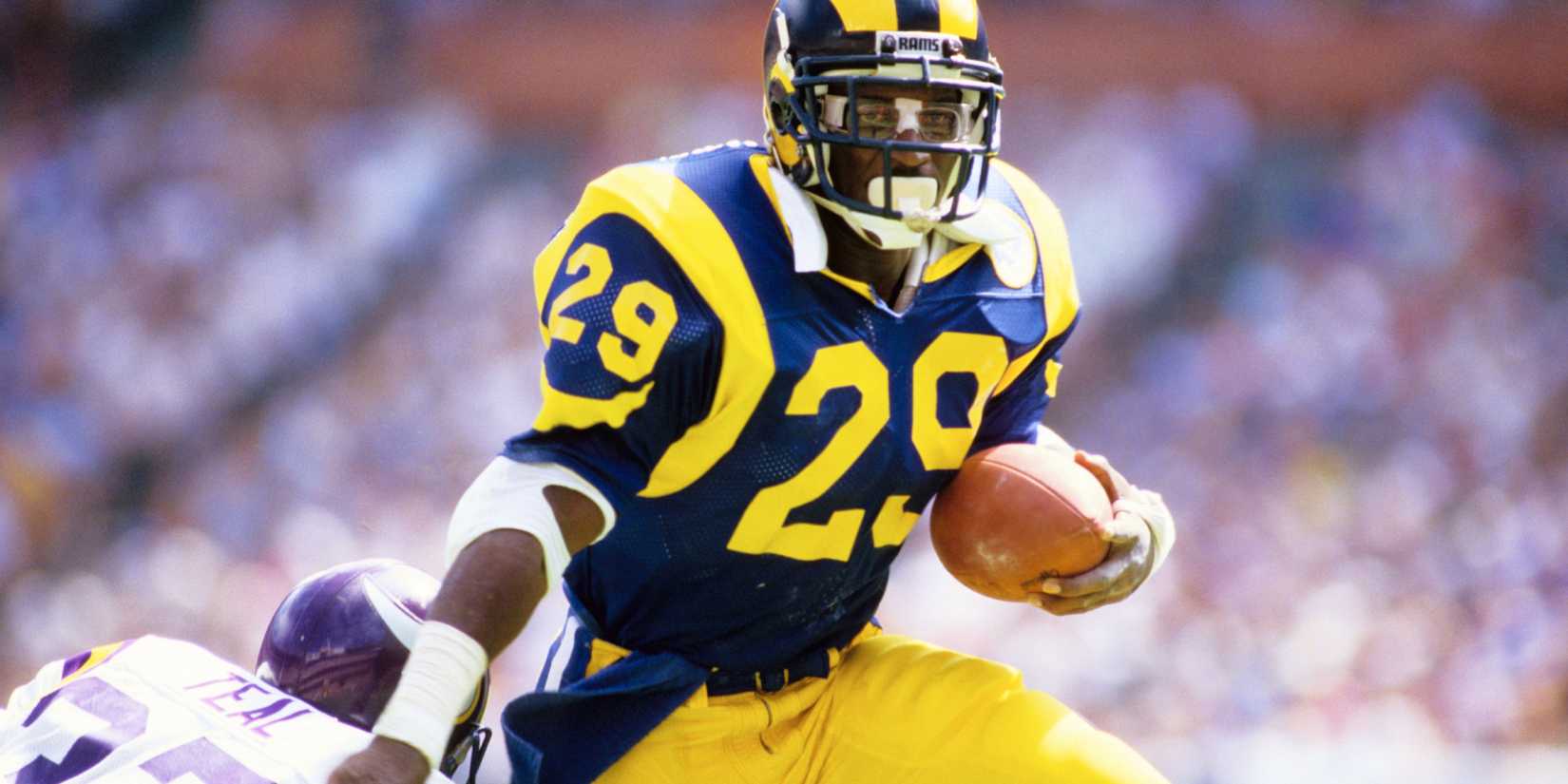
It was evident early in Eric Dickerson’s career that he was destined for greatness. As a rookie, he led the league with 1,808 rushing yards and 2,212 yards from scrimmage. He then followed it up with an even more impressive second season where he broke the single-season rushing yards record with 2,105 yards, which remains unbroken 40 years later.
| Eric Dickerson Career Stats | ||
|---|---|---|
| Stat | Regular season | Playoffs |
| Games | 146 | 7 |
| Rushing Yards | 13,259 | 724 |
| Yards Per Carry | 4.4 | 4.9 |
| Rushing Touchdowns | 90 | 3 |
| Receptions | 281 | 19 |
| Receiving Yards | 2,137 | 91 |
| Receiving Touchdowns | 6 | 1 |
| Fumbles | 78 | 7 |
A former track star, Dickerson’s running style mirrored that of a sprinter. He ran tall and upright in the open field and used his long strides to pull away from defenders. Despite his lankier build, Dickerson was an incredibly fluid runner who could stop and change direction at will.
If Dickerson were guilty of any crime, it would be that he was so great so early on in his career it set an impossible standard. He recorded 4,456 yards from scrimmage in his first two seasons, and that just simply wasn’t sustainable. He still had his moments, going on to lead the league in rushing twice more, but Dickerson was forever chasing his 1984 self.
A few years after he was traded from the Los Angeles Rams to the Indianapolis Colts, Dickerson hit a wall and spent the final years of his career in a limited role. As far as peaks go, no ranking for Dickerson should be considered too high. His four best seasons could go toe-to-toe with anyone’s. Unfortunately, career greatness comes down to more than just your four best years, which keeps Dickerson out of the top five.
9
O.J. Simpson
Simpson made five consecutive All-Pro teams
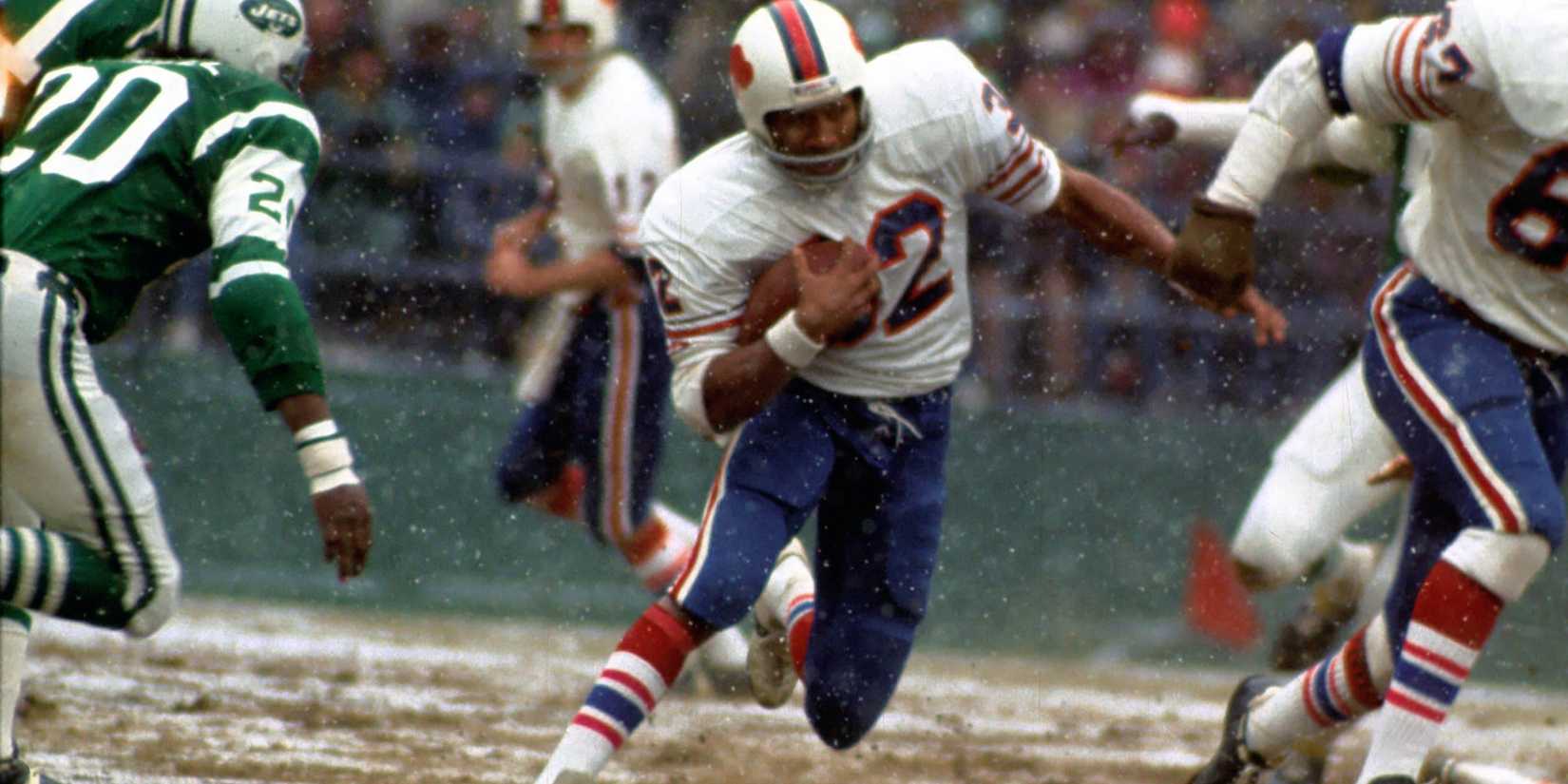
It’s challenging to discuss O.J. Simpson’s legacy without mentioning his off-field actions. His role in one of the most infamous murder trials of the 20th century has made his football career an afterthought. Strictly focusing on on-field performance, Simpson is wholly deserving of an admission.
| O.J. Simpson Career Stats | ||
|---|---|---|
| Stat | Regular season | Playoffs |
| Games | 135 | 1 |
| Rushing Yards | 11,236 | 49 |
| Yards Per Carry | 4.7 | 3.3 |
| Rushing Touchdowns | 61 | 0 |
| Receptions | 203 | 3 |
| Receiving Yards | 2,142 | 37 |
| Receiving Touchdowns | 14 | 1 |
| Fumbles | 62 | 0 |
Simpson’s career got off to a rather slow start with the Buffalo Bills, which is uncharacteristic for a running back. Once he found his stride, though, he was an unstoppable force.
From 1972-1976, Simpson led the league in rushing four times and in touchdowns twice. Simpson also maintained outstanding efficiency despite the high usage, averaging over five yards per carry for three of his four rushing titles.
The 1973 season saw Simpson at the peak of his powers. He ran for 2,003 yards, becoming the first to ever hit the 2,000-yard mark, on six yards per attempt and won MVP. Most impressive of all, Simpson did this in only 14 games.
His per-game averages extrapolated to a 17-game sample would give him 2,433 yards and 14 touchdowns. This wasn’t even his best season from a total yardage standpoint, as he recorded 2,243 yards from scrimmage and 23 total touchdowns in 1975.
No one should sympathize with Simpson, as his fall from grace was entirely self-inflicted. As just a running back, though, he was one of the defining talents of his time and his greatness on the gridiron is hard to ignore 50 years later.
10
Earl Campbell
Campbell’s early-career dominance cements him as one of the greats
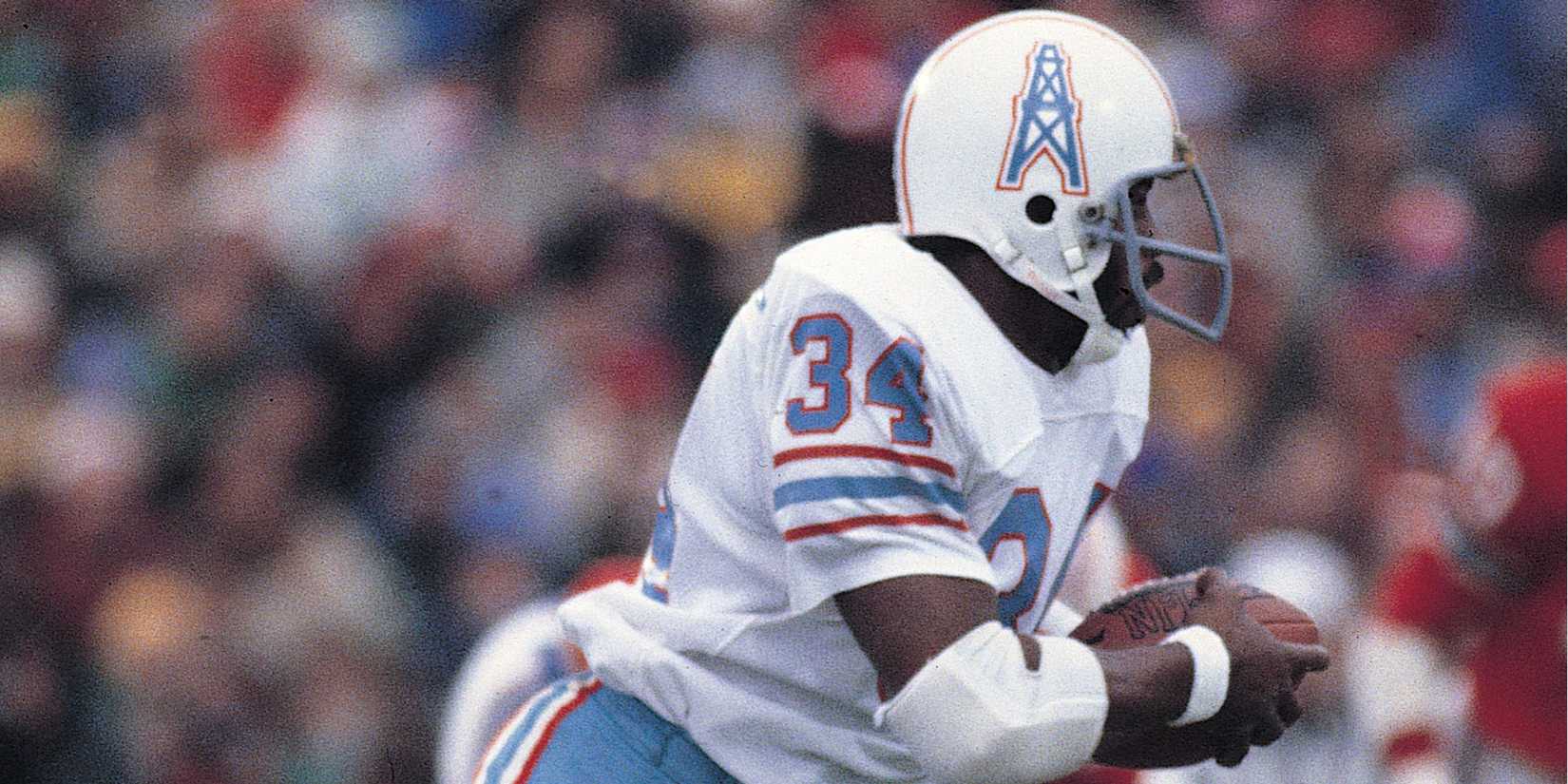
Earl Campbell hit the ground running in the NFL. In his first three seasons with the Houston Oilers, he won three Offensive Player of the Year awards, three rushing titles, and the 1979 MVP.
Listed at 5-foot-11 and 232 pounds, Campbell was a unit with a thick, muscular build and an exceptionally strong lower body. However, his size and strength didn’t come at the expense of speed and explosiveness. When Campbell had reached full speed, defenders were at his mercy.
| Earl Campbell Career Stats | ||
|---|---|---|
| Stat | Regular season | Playoffs |
| Games | 115 | 6 |
| Rushing Yards | 9,407 | 420 |
| Yards Per Carry | 4.3 | 3.1 |
| Rushing Touchdowns | 74 | 4 |
| Receptions | 121 | 5 |
| Receiving Yards | 806 | 45 |
| Receiving Touchdowns | 0 | 0 |
| Fumbles | 43 | 6 |
Campbell’s running style embodied violence and brutality. Taking him down on first contact was nearly impossible, and it often took a committee of defenders to eventually drag Campbell down. Physically speaking, Campbell was a man among boys and punished opposing defenses, but his punishing running style also took a psychological toll on opponents, wearing them down as the game progressed.
Sadly, Campbell’s style of play wasn’t sustainable. After his historic start, Campbell recorded just two more 1,000-yard seasons and was out of the league by the end of his eighth season. Still, Campbell more than left his mark on the sport and remains one of the greatest running backs of all time.
Source link


