Martha Firestone Ford’s Lions Legacy Joined Stewardship With Community Investment
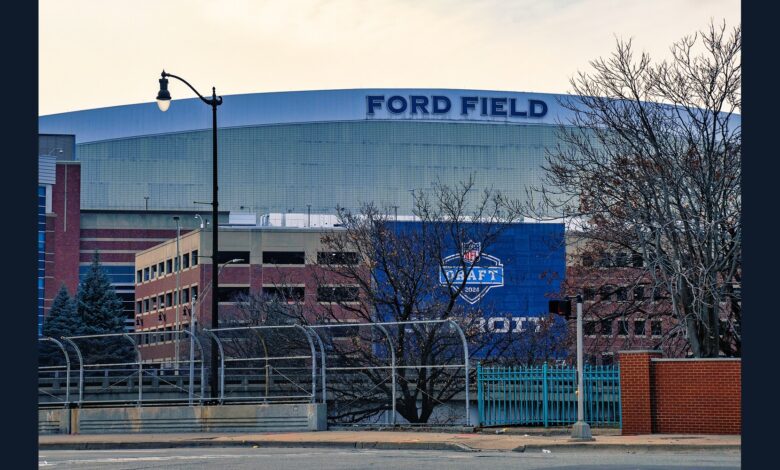
Archival and illustrative photograph: Ford Field in downtown Detroit on January 10, 2023. Photo by Tony Webster via Wikimedia Commons. Licensed CC BY 2.0. Shown in a full-frame presentation with neutral borders added by HuddleUp to preserve the complete original composition; no image content was removed. This archival stadium photograph does not depict Martha Firestone Ford, her family or the November 24, 2026 announcement.
Event/update date: November 24, 2026
Martha Firestone Ford, the Detroit Lions’ owner and chair emeritus, died Tuesday at her home in Grosse Pointe, Michigan, surrounded by family. She was 101. The team announced her death on November 24 and did not state a cause.
Ford’s connection to the franchise spanned more than six decades. She and her husband, William Clay Ford Sr., took full control of the Lions in 1963. After his death in 2014, she became the principal owner and chair. She moved to emeritus status in 2020 as their daughter Sheila Ford Hamp assumed leadership.
Her tenure mixed continuity with visible intervention
Family continuity defined the ownership structure, but Ford did not treat continuity as a reason to avoid change. The Lions reached the playoffs in 2014, her first season as principal owner, then lost seven of their first eight games in 2015. She dismissed the team president and general manager during that season and began another leadership search.
The Associated Press described that decision as a clear sign that a low public profile did not mean passivity. Detroit returned to the playoffs in 2016 after the organization hired Bob Quinn as general manager. The Lions did not achieve the sustained competitive breakthrough the franchise sought during her six years in control, but her record shows a willingness to change the structure when results did not meet expectations.
Analysis: Stewardship is sometimes mistaken for preserving every existing practice. Ford’s tenure offers a different definition: protect the institution, remain present and still accept that inherited systems may need new leadership. That combination matters in a family-owned franchise, where personal loyalty and organizational accountability can easily become confused.
Investment in Ford Field carried a longer horizon
The Lions credited Ford with a major 2017 investment in Ford Field. The club described that work as a foundation for the game-day environment fans experience now. Stadium improvements are easy to frame as a one-season business project, but their value is measured across years of events, employees, fans and community activity.
Her presence also continued after the formal transition to emeritus status. The team said she supported her four children as they assumed leadership responsibilities and remained a fixture around the franchise. The AP reported that she attended a Lions victory over Minnesota earlier this month.
That detail gives the transition greater context. Ford did not simply transfer a title and disappear. She remained close enough to provide continuity without publicly competing with the next generation for control. Healthy succession requires both parts: a new leader must have real authority, and the former leader must know how to support without reclaiming the role.
Community work was part of the ownership record
The Lions’ remembrance placed community investment alongside football operations. Ford expanded Detroit Lions Charities and served as a longtime trustee of Henry Ford Health. She held leadership roles with organizations serving children, education and Detroit-area families.
In 2019, Ford and Lions players made an initial financial commitment to launch Detroit Lions Inspire Change, a social-justice initiative that remains part of the organization’s philanthropic work. She also helped establish the Henry Ford Maplegrove Center, which provides substance-use treatment and related care.
Those programs show why an owner’s legacy cannot be evaluated only through wins and losses. A franchise has employment power, public visibility, facilities and long-term relationships that can shape a city. Community commitments are most credible when they survive the announcement, the season and the individual leader.
The franchise now carries a multigenerational responsibility
Ford is survived by four children, 14 grandchildren and 17 great-grandchildren. Her daughter Sheila Ford Hamp remains the Lions’ principal owner and chair, while other family members hold ownership and vice-chair roles.
The team’s statement emphasized values, love and passion carried across generations. The stronger test of that language will be institutional: whether leadership standards, community programs and investment continue to evolve instead of becoming frozen as memorial language.
Ford’s life connected the Firestone and Ford families, two names central to American industrial history. Her football legacy was quieter than that public symbolism. It was built through presence, decisions during difficult seasons, a managed leadership transition and civic work attached to the franchise.
Detroit can honor that record without turning it into an uncomplicated story. The Lions’ competitive history included long frustration as well as periods of progress. Her leadership mattered because she stayed responsible for both—the organization she inherited and the community it served.
Sources
- Detroit Lions: Martha Firestone Ford dies at 101
- Associated Press: Ford’s life, ownership and Detroit impact
Join the Huddle for email updates.
Explore HuddleUp Magazine’s published NFL coverage portfolio. This desk report is continuing coverage and is not presented as on-site Media Week reporting.
Newsroom transparency: This AI-assisted desk report was produced from the linked public sources and edited for accuracy and context. HuddleUp did not conduct an on-site interview. Read our Editorial Standards & Transparency.