
Luton Town’s rapid rise left the women’s team behind – is this about to change?
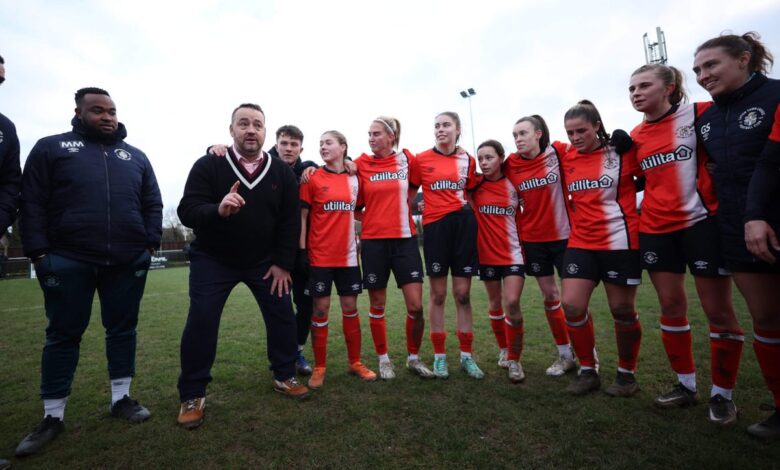
The quiet of Barton-le-Clay, a Bedfordshire village that dates back to 1066, has been disrupted.
‘Car park full’ has been chalked onto a sandwich board at the entrance to Sharpenhoe Road, the home of non-League team Barton Rovers. There is a backlog of cars being forced to reroute and a queue of Luton Town fans stretching back the length of two coaches.
They are here to watch Luton Town Ladies host Women’s Super League (WSL) side Brighton & Hove Albion in the fourth round of the FA Cup.
Fifth-tier Luton were the lowest-ranked side left in the competition. It has taken Luton five wins (against Grays Athletic Wodson Park, Harpenden Town, Enfield Town and Keynsham Town) to bring a Brighton team captained by the Champions League-winning midfielder Vicky Losada to Barton-le-Clay.
The 32-year-old forward Samaira Khan (who is the same age as Losada) is to thank for Luton getting this far in the cup: Khan’s late header against Keynsham Town set up the Brighton tie. With FA Cup prize money having doubled, Luton’s earnings tallied at £56,000 ($71,000) before kick-off. And even in losing 6-0 to Brighton, they collected another £13,000.
This cash boost will not mean Luton can begin to pay their coaching staff or players, but it will also help with rising training and playing costs. Everyone working full-time at the club — which has close to 300 players from ages five upwards — does so at their own cost, with only a matchday physiotherapist getting paid. This FA Cup run has been a lifeline.
“It will see us through for the rest of this season, next season and then it depends on the overheads as they keep going up and up,” says club secretary David Baker, who founded the team in 1997.
Baker has held many roles at the club, including a stint as manager from 2001 to 2013. His daughter Nikki Baker — who rose through the youth ranks before coming captain — followed in his footsteps, managing the club from 2013 to 2022. She now holds the position of general manager, with Rob Burton leading the team.

Nikki Baker, left, with her father David before the Brighton match (Caoimhe O’Neill)
“It’s been tough,” Nikki says. “Dad and I have run this club for 20 years until Mark Wareham recently became chairman. He’s been a big help and bridged the gap.”
With Luton men’s team now in the Premier League, some feel this ought to have a positive knock-on effect for the women’s team, who hire local school pitches to train on twice a week after previously training at the men’s academy. The men’s club has donated kits and promoted the Brighton game to their followers, while the women’s team have played at Kenilworth Road in the past.
And although the Bakers say no funds have ever been received by the women and girls teams, with men’s club chairman David Wilkinson and director Paul Ballantyne both present at Sharpenhoe Road, there is hope that this is about to change.
“We are trying to do a lot more with the ladies’ side because we haven’t worked as hard as we should have done over the years. But now we are — and it’s exciting,” Wilkinson tells The Athletic.
Wilkinson was involved in the 2008 takeover of the men’s club and had not expected the side to be playing in the top flight so soon after being promoted from the National League in 2014. “Because we have moved so fast, everybody gets left behind — they can’t grow as quickly. The academy took years to catch up (to the men’s team) and it still hasn’t. This is a family club so this has got to be more important, but you can’t do everything at once.”
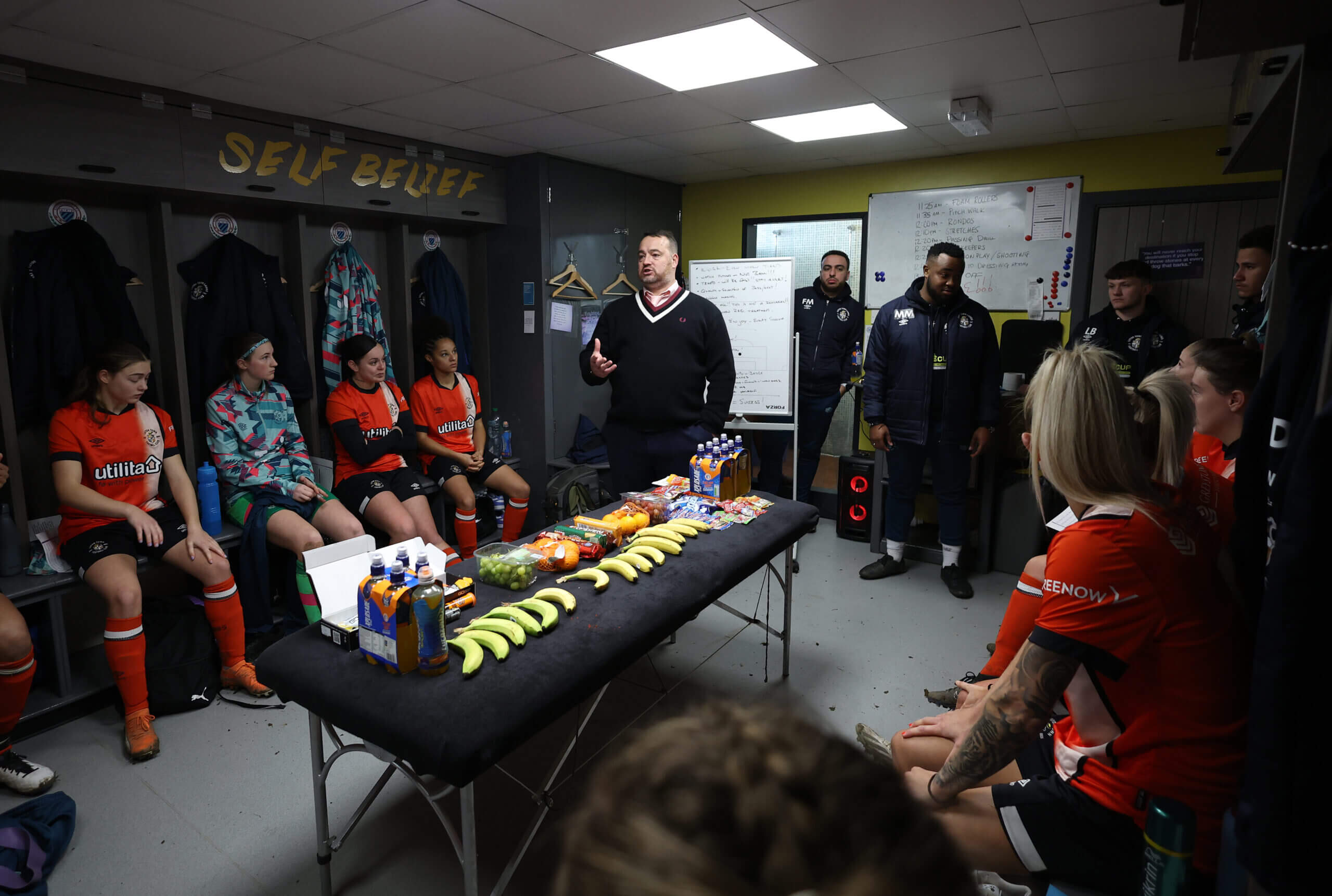
Burton and his players before the game (Eddie Keogh – The FA via Getty Images)
Wareham and the Bakers both say the relationship between the men’s and women’s sides has significantly improved in recent months. The arrival of club operations manager James Mooney is pointed to as a key factor.
“If they were to give us £20,000 as a lump sum that would be great — but how do you split that between players and facilities?” Nikki asks. “There are local clubs in our league that are paying players.
“Brighton’s players are paid to play; our players do it for the love of the game. If they don’t get a sponsor, they have to pay to play. It is not even the financial support we necessarily need, (even if) that helps — it’s facilities. Going forward, it’s more than just a lump sum (that we want), it’s about overall support.”
Head coach Myles Maddix — whose sister Leyah Maddix is the team’s No 9 — works as a teaching assistant in a local school. He admits balancing both roles can be difficult but feels especially worth the graft on days like this.
“We are hoping to build those relationships with the men’s team so it elevates us and we can push ourselves to go higher up the ladder,” he says.
Back in the 2008-09 season, the team won promotion to the FA Women’s National League North (third tier). It meant playing teams such as Liverpool, Manchester City and Aston Villa — but the travelling involved took its toll on the club and their players, both physically and financially.
And while Bakers admit that season almost broke the team’s spirit, they are back to dreaming big again: emulating their male counterparts to reach the top division. And how they shut out Brighton for the first 33 minutes of their FA Cup tie and limited them to two goals in the first half has only breathed more belief into that dream.
Luton’s 39-year-old goalkeeper and their player of the match, Amy Butler, is one such believer.
To give a flavour of Luton’s blend of youth and experience, Butler, a train manager, started alongside 17-year-old student Keira Palmiero. Butler works as second in command to the driver between Kings Cross and Edinburgh. As Butler talks, her hands are still warm from the 25 shots (14 on target) she faced.
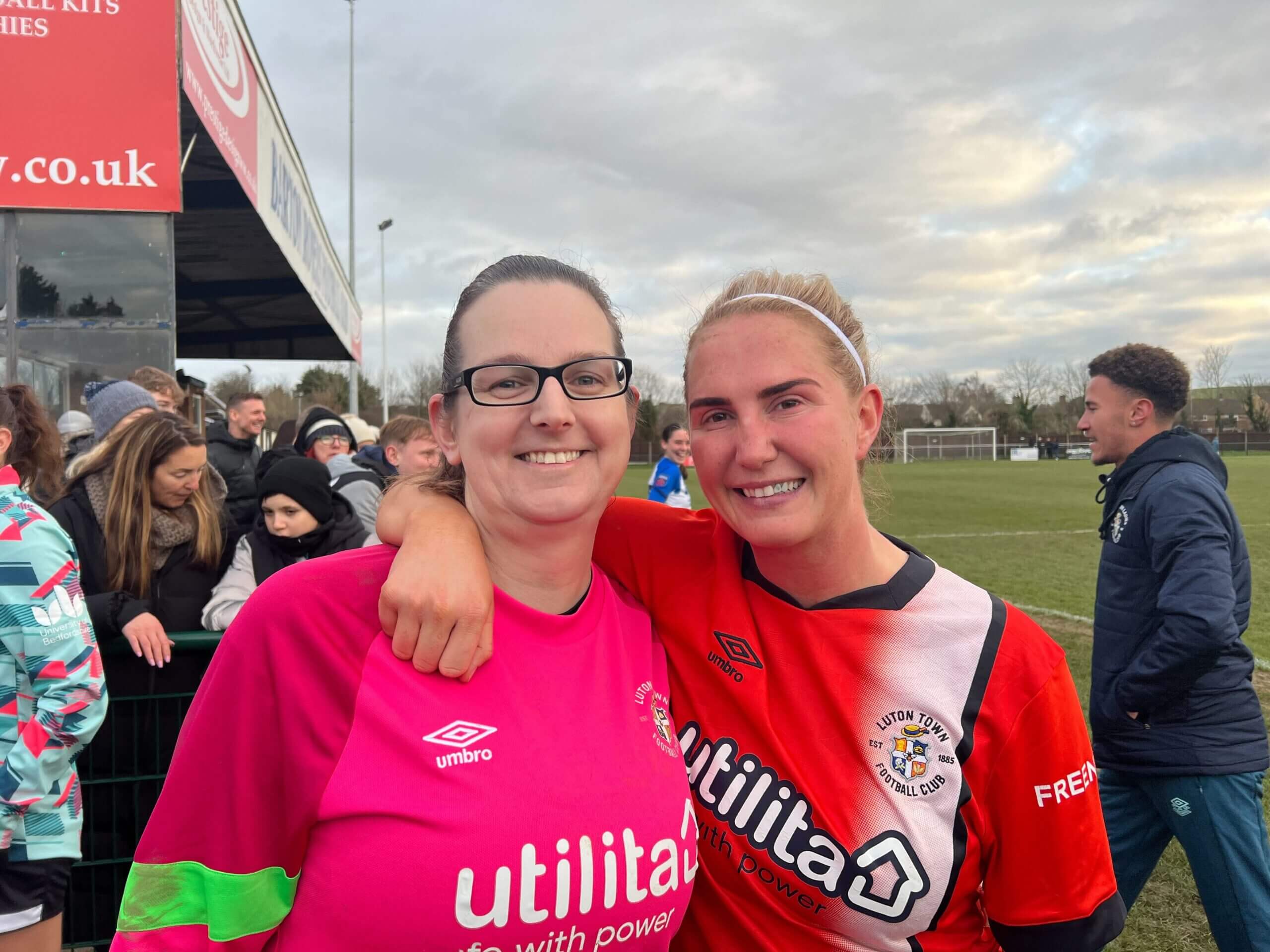
Luton’s goalkeeper Amy Butler (left) and centre-back Tanya Blacksley (Caoimhe O’Neill)
“My back will not thank me tomorrow,” Butler, who celebrates her 40th birthday in two weeks, says, laughing. “I’ve had to roll back the years for this one. I’m at work tomorrow, going to York and back. I don’t think the Brighton players will be doing that.”
Centre-back Tanya Blacksley, who works in a secondary school in Hackney, will also return to her day job on Monday.
Blacksley and her fellow centre-back Elly Wade — a 3D visual artist and the team’s volunteer social media manager — headed and hoofed as many Brighton attacks as they could. One football was lost on the clubhouse roof and another to the fields behind the goal. As they headed into the bar to celebrate the occasion with team-mates and fans at full time, there was an air of hopefulness for the future.
“That’s fantastic,” Blacksley says when made aware of Wilkinson’s comments. “It’s small steps — now we will see where we can go from here.”
(Top photo: Eddie Keogh – The FA via Getty Images)
Source link


