
‘There isn’t a black offensive coaching tree:’ What can be done to bolster the pipeline of minority coaches on offense?
The path to becoming an NFL head coach has never been fair for everybody.
Even today, the percentage of minority coaches is paltry compared to that of the players. But at least there appeared to be a consistent criteria for rising through the ranks over the past couple of decades: You pay your dues by dominating two or three different roles — play-caller, assistant head coach, interim head coach, college head coach — and then prepare for the big interview.
The NFL’s recent hiring cycle proves the criteria has changed, and it benefits an almost exclusively white pool of job candidates, those entrusted to be around quarterbacks and implement offensive strategies.
The 2019 coaching cycle was dominated by offensive minds; six, all white, filled eight vacancies. The Miami Dolphins made New England Patriots defensive play-caller Brian Flores the lone minority promotion.
The 2018 cycle included one minority for seven openings. The Arizona Cardinals hired Steve Wilks and fired him one year later in favor of Kliff Kingsbury.
“You know, it’s funny how the hiring process has changed,” Los Angeles Chargers head coach Anthony Lynn said. “When I was coming up, I had to check this box, that box and this box before I got hired as a head coach. Now, there are guys getting jobs that didn’t check the boxes, guys who didn’t call plays, who didn’t have experience. I just want to see consistency in the process. Don’t tell one party one thing and do another with the other party.”
Lynn is black. He was a backup running back on the Denver Broncos’ back-to-back championship teams in 1998-99. He started his coaching career in 2000 as a special-teams assistant and served as a running backs coach for four teams, became the New York Jets assistant head coach in addition to handling running backs and followed Rex Ryan to the Buffalo Bills, where Lynn was assistant head coach again, then offensive coordinator when Greg Roman was fired, then interim head coach when Ryan was fired. After 17 years of coaching experience around the league, he was hired for his first NFL head coaching job in January of 2017.
Have you seen Kingsbury’s resume? Zac Taylor’s?
Jimmy Raye isn’t sure if the disparity is amusing or tragic.
Back in the 1980s, Raye was considered a smart bet to become the NFL’s first African-American head coach. He knew all about NFL prejudices, as he’d been a star Michigan State quarterback who was forced to convert to defensive back upon being drafted in the 16th round.
Raye was successful enough as an offensive coordinator to hold the job for seven teams. He called the plays for Eric Dickerson’s first two seasons, when the Hall of Famer averaged 1,957 rushing yards and 16 touchdowns. Raye called Joe Montana’s plays with the Kansas City Chiefs while simultaneously coaching running backs (Marcus Allen, Greg Hill, Barry Word) and tight ends (Tony Gonzalez).
Raye received four head-coaching interviews over his 36-year career, yet never heard a precious offer.
Now youngsters snag jobs as entry-level grunts and soon find themselves heralded as the next offensive genius. You’ve never heard of the kid, Raye half-joked, but five years later, “the guy’s a head coach somewhere.”
In today’s NFL, minority coaches don’t get remotely the same chance as white coaches when it comes to head-coaching opportunities. If the trend continues, then candidates of color will remain at a titanic disadvantage in filling those top jobs.
“You almost have to have an Obama-like aura to get an opportunity.”
As each of the NFL’s 32 clubs makes a coaching hire, it is confident the best possible decision — without prejudice — was made for the organization.
Once all this year’s jobs were filled, however, only four minority head coaches existed, half the number from the season before and the NFL’s lowest number in 17 years.
“We have to judge our progress on the results,” Pittsburgh Steelers owner Art Rooney II said. “It’s like looking at your team. You are what your record says you are.”
The Rooney Rule was named after Art’s father, Dan Rooney, the leading advocate for the NFL’s 2003 policy that mandated at least one diverse candidate be interviewed for each head-coaching vacancy. The policy was expanded in 2009 to personnel positions that control a team’s roster.
“I’m not going to sit here and accuse anyone of racism,” Art Rooney II said, “but the facts are what they are. We have to look at the opportunities that were given to minorities this latest round and see what can be done about it.”
Owners are infatuated with discovering the next Sean McVay, their very own visionary to install progressive offensive strategies and light up scoreboards like pinball machines.
But minority coaches can’t seem to earn the system’s trust when it comes to getting close to quarterbacks and calling offensive plays. Football has failed to develop minority assistants in the most crucial roles that groom future head coaches: offensive coordinators, quarterbacks coaches and even the entry-level positions that have become increasingly vital to launching careers.
Twenty NFL head coaches have offensive backgrounds. Eleven come from defense, one from special teams. With the eight coaching changes this winter, the NFL gained two more offensive bosses than it had in 2018.
Excitement over an offensive renaissance contributed to brow-raising hires that left coaches of color frustrated over the system as much as the decisions.
Kliff Kingsbury, a former NFL player with no NFL coaching experience, was hired by the Cardinals in January. (Photo by David K Purdy/Getty Images)
Texas Tech fired Kingsbury last year for going 35-40. He never was an NFL assistant. Yet the Cardinals made him their next head coach because he worked with future NFL quarterbacks Case Keenum, Patrick Mahomes and Baker Mayfield. Kingsbury himself didn’t think he was NFL material in December. He signed to be Southern California’s offensive coordinator before exploding into a surprise commodity.
The Cincinnati Bengals hired Taylor. He has five games of play-calling experience, a responsibility granted three years ago from his father-in-law, Mike Sherman, the Dolphins’ coach at the time. But Taylor was the Los Angeles Rams’ quarterbacks coach under McVay last year.
Matt LaFleur, the new Green Bay Packers coach, was McVay’s offensive coordinator in 2017 but has extensive experience as a play-caller and quarterbacks coach elsewhere.
The Cleveland Browns promoted Freddie Kitchens despite eight games as a play-caller in hopes of maintaining a relationship with Mayfield and building off an encouraging rookie season.
Minority offensive coaches, meanwhile, couldn’t get an offer.
“You almost have to have an Obama-like aura to get an opportunity,” independent passing instructor George Whitfield said. “There’s no such thing as a flier. It’s not like you have to come in with a five-pound resume anymore.
“This job cycle showed you need a recommendation and a thumbs up from somebody.”
“For whatever reason, you rarely hear them talk about black coaches as gurus. I don’t think that’s accurate or fair.”
All but two offensive coordinators are white in a league where 72 percent of the players, 37.4 percent of the assistant coaches and 12.5 percent of the head coaches are minorities. The lack of minorities getting NFL offensive coordinator jobs is more disconcerting in light of the job’s turnover rate.
Only three NFL offensive coordinators have been with their teams longer than two seasons. Pete Carmichael has been with the New Orleans Saints since 2009, Josh McDaniels with the New England Patriots since 2012 and Ken Whisenhunt with the Chargers since 2016.
Despite the shortfall of minority offensive coordinators, influential voices are against extending the Rooney Rule to include coordinator interviews.
“The coach has got to be able to pick the guy he wants, black or white, yellow or green,” said John Wooten, chairman of the Fritz Pollard Alliance. The group, named after the NFL’s first black quarterback, promotes development of minority coaches and executives.
“A head coach should already know what guy he wants when he gets the job, and you’ve got to give him that right,” Wooten said. “Otherwise, why did you make him the head coach?”
Rooney agreed in general, but the Steelers’ owner conceded all options should be considered when exploring ways to improve the number of minorities as offensive coordinators. Rooney serves on the powerful NFL Chairmen’s Committee to “spearhead initiatives aimed at defining and identifying league priorities and ensuring that issues are properly considered and coordinated” and the Workplace Diversity Committee.
“I wouldn’t be opposed to looking at it,” Rooney said of coordinators, “but I would say the real question in my mind is how do we make sure there are people coming into the pipeline that have the opportunity to move up into these positions.
“If you don’t have people coming up through the ranks, you can have all the rules about interviewing that you want, but this is not a program where you require teams to hire minorities.”
Rooney was more inclined to shine a spotlight where the coaching-career path begins than to mandate minority interviews for every coordinator hire.
“That’s a place to look,” Rooney said. “The entry-level positions are important. That’s where it starts, and if we’re not getting diverse candidates into the pool at that point, then you’re not going to get them at the higher level eventually.”
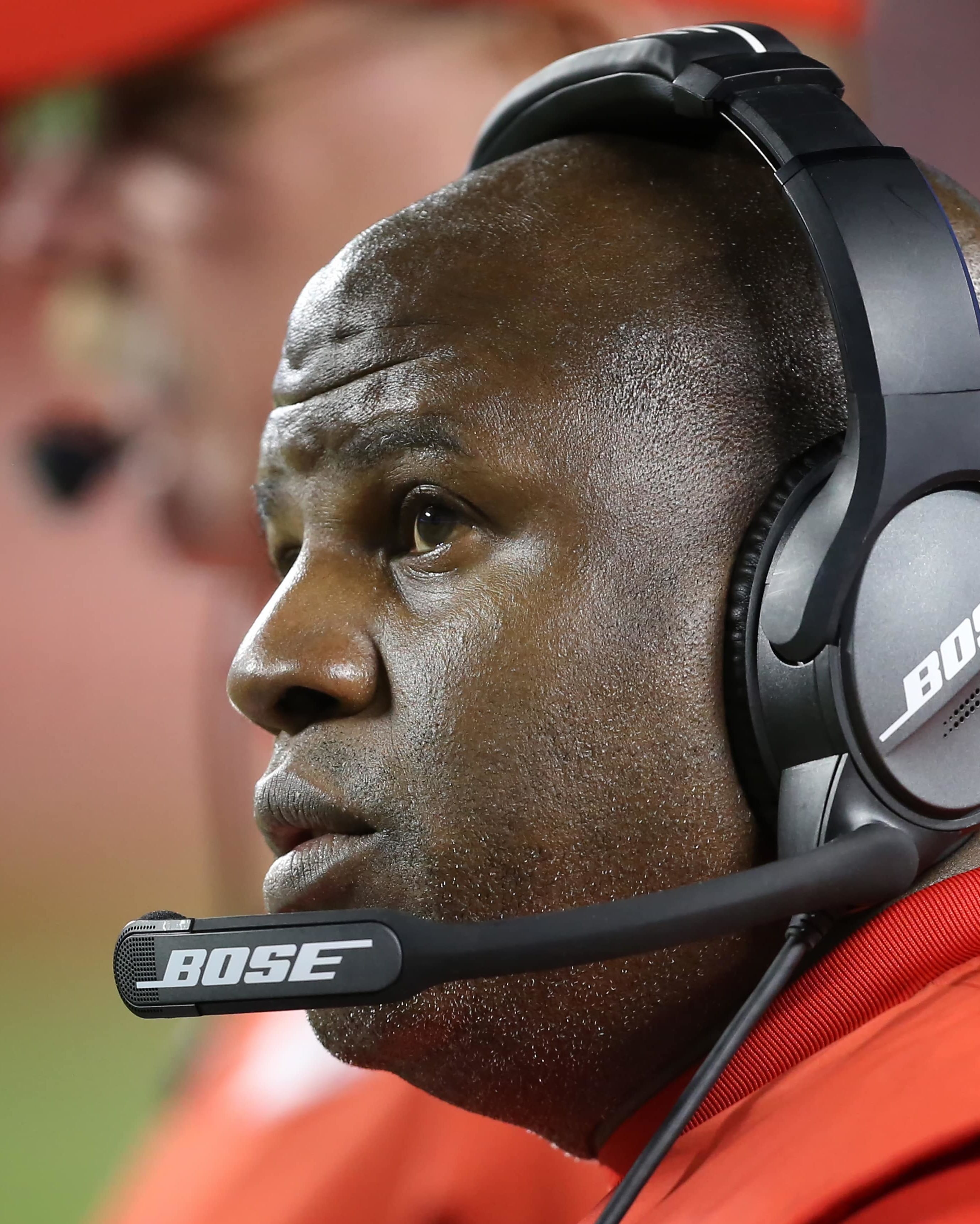
Chiefs OC Eric Bieniemy struck out multiple times this hiring cycle. He interviewed for the Dolphins, Jets, Buccaneers and Bengals jobs. (Photo by Scott Winters/Icon Sportswire via Getty Images)
Some who monitor progress for coaches of color are hesitant to condemn the trend. Nearly a third of NFL defensive coordinators are minorities. Teams historically have been far more receptive to giving chances on that side of the ball. Perhaps owners and general managers soon will become enamored with defensive-oriented coaches again.
While the first two black head coaches in modern NFL times, Art Shell in 1989 and Dennis Green in 1992, were offensive-minded, 15 of the 18 minorities since who have become head coaches stemmed from a defensive background.
“It’s not as though the minority players are on one side of the ball,” Rooney said. “So I don’t think minority coaches should be on one side of the ball.”
Dallas Cowboys defensive backs assistant Kris Richard and Chiefs offensive coordinator Eric Bieniemy are black aspirants who struck out multiple times this hiring cycle. Each interviewed for the Dolphins, Jets and Tampa Bay Buccaneers jobs. Bieniemy also met with the Bengals.
“The narrative that’s being written is pretty funny,” Richard said, “because what defensive coaches do is spend their whole entire time teaching offense. So the idea that this particular guy, because he’s on defense or this guy because he’s on offense, doesn’t know one way or the other is pretty comical to me. Who’s a leader of men? Those are head coaches.”
But the game’s inclination to emphasize offense is irrefutable, maybe even irreversible. Rules and systems increasingly boost the importance of QB play, QB development and QB psychology.
Coaches who oversee quarterbacks and offensive strategy overwhelmingly are white. So are their entry-level assistants, many of whom find clearer paths to prominent roles than veteran position coaches.
“It’s the same stigma as black quarterbacks,” Players Coalition co-founder and Philadelphia Eagles safety Malcolm Jenkins said. “We rarely talk about black quarterbacks in the context of being cerebral or being able to play chess at the line of scrimmage. It’s always about dual threat, mobility and flash plays.
“For whatever reason, you rarely hear them talk about black coaches as gurus. I don’t think that’s accurate or fair.”
Bieniemy is Kansas City’s offensive coordinator, but head coach Andy Reid calls the plays. Byron Leftwich, also black, will handle the plays for new Tampa Bay head coach Bruce Arians.
There are five minority quarterbacks coaches: Marcus Brady in Indianapolis, Jim Caldwell in Miami, Dave Canales in Seattle, Clyde Christensen in Tampa Bay and T.J. McCartney in Denver.
That adds up to seven minorities in 64 possible spots among NFL offensive coordinators and quarterbacks coaches.
“You’re telling me that’s all the qualified individuals that our game has?” Whitfield said. “The succession plan is non-existent. There isn’t a black offensive coaching tree. Arguably, Sean McVay’s coaching tree already outdraws theirs.”
“If we’re keeping it 100, minorities seem to get stuck with the receivers or the running backs and can’t move up. They get stuck in the shuffle.”
Other offensive positions provide stark contrasts.
Two offensive line coaches are minorities. “Pitiful,” Wooten said of the tally. Buccaneers run game coordinator Harold Goodwin would be a third. Goodwin is an O-line coach by trade although Joe Gilbert has the title.
Five tight ends coaches are minorities.
Only five running backs coaches and 13 receivers coaches are white, but those positions aren’t considered launching pads toward head opportunities.
“If we’re keeping it 100,” said Broncos cornerback Chris Harris Jr., “minorities seem to get stuck with the receivers or the running backs and can’t move up. They get stuck in the shuffle.”
Oakland Raiders boss Jon Gruden is alone in elevating primarily from a receivers background. Other head coaches have worked with receivers, but spent more time with other positions.
Lynn and Kitchens are the only NFL head coaches who primarily coached running backs on the way up.
Raye wondered how an assistant as successful as Patriots running backs coach Ivan Fears hasn’t been interviewed to be an NFL offensive coordinator, let alone a head coach. Fears, who’s been an NFL coach since 1991, has won six Super Bowl rings with New England. He spent 10 years as a wide receivers coach (for the Patriots, Bears and Patriots again, where he won the first ring in 2001), before spending the last 17 years in charge of New England’s running game.
“The institutionalized racism is with the running backs and wide receivers coaches,” Raye said, “and then it’s hard to transition over.”
David Culley realized the trend and didn’t want to be pigeonholed. Culley last year was one of four minority quarterbacks coaches. He previously spent three decades as a receivers coach, but knew that role stunts upward mobility. When Sean McDermott became Bills coach in 2017, he gave his former Eagles colleague the chance to work with the most lucrative group.
Culley, who hadn’t coached quarterbacks since 1988 at Southwestern Louisiana, found himself in charge of seventh overall draft choice Josh Allen last year.
“Isn’t that fascinating?” Whitfield said. “To coach that position at that level, working with a rookie, with all the position’s complexities, and you have never done it. On the fly, in real time, we will teach you how to train and guide a fighter pilot. We know you’ve never flown, but you can help teach fighter pilots.
“Just imagine that!”
The Baltimore Ravens last month hired Culley as assistant head coach, receivers coach and passing-game coordinator under play-caller Roman. But now Culley can say he coached quarterbacks, a detour that could make the difference in landing a big interview.
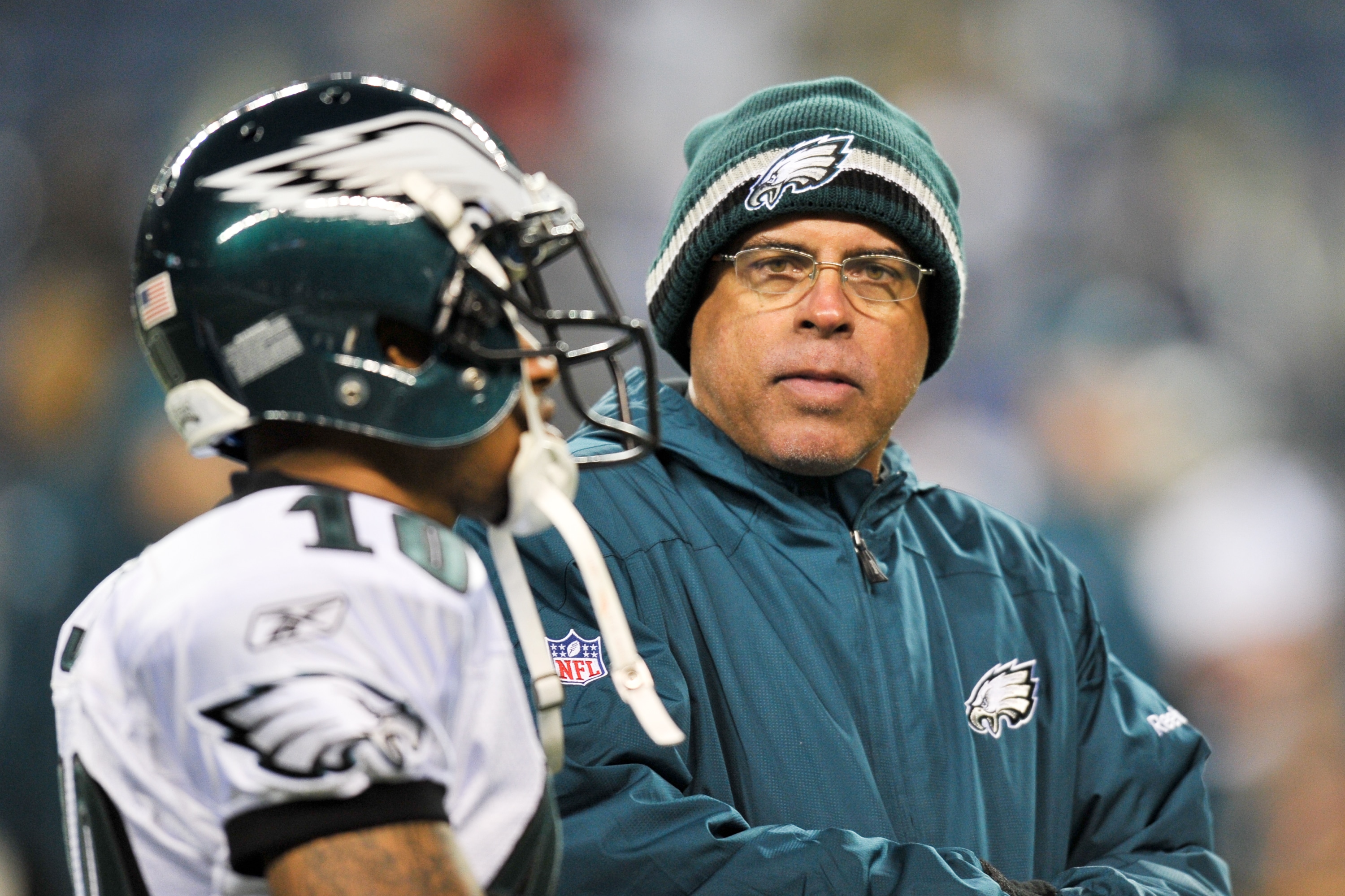
Current Ravens assistant head coach David Culley spent three decades as a receivers coach, but knew that role stunts upward mobility. (Photo by Drew Hallowell/Philadelphia Eagles/Getty Images)
Meanwhile, college programs haven’t helped the pipeline much.
The Power Five conferences comprise 64 universities. They employ 13 minority head coaches. There are 16 minority offensive coordinators, although nine of them are designated “co-coordinators,” sharing the job with another coach. The Power Five has seven minority quarterbacks coaches.
Most diverse is the Pac-12, with five head coaches, three offensive coordinators (all of whom handle quarterbacks) and one standalone quarterbacks coach of color.
Least diverse is the SEC, with one head coach, one offensive coordinator, two co-coordinators and one quarterbacks coach of color over 14 programs.
“Those play callers exist at the collegiate level,” said Troy Vincent, NFL executive vice president for football operations.
“The numbers are very scarce here at the National Football League from a play-calling standpoint.”
Vincent listed some of the top collegiate minority prospects: Kodi Burns (Auburn co-offensive coordinator/wide receivers coach), Billy Gonzales (Florida co-offensive coordinator/wide receivers coach), Bush Hamdan (Washington offensive coordinator), Ivin Jasper (Navy offensive coordinator), Brian Johnson (Florida quarterbacks coach), Shaun King (South Florida running backs coach), Mike Locksley (Maryland head coach), Bryan McClendon (South Carolina offensive coordinator), Scottie Montgomery (Maryland offensive coordinator) and Tavita Pritchard (Stanford offensive coordinator).
None has received an NFL head-coaching interview.
“Yet Kliff Kingsbury gets fired at Texas Tech and gets a shot,” Wooten sighed.
Kingsbury was the lone college coach to be interviewed for any of the NFL’s eight head-coach openings. He met with the Cardinals and Jets.
“The position, either those playing it or coaching it, still is an extremely guarded one,” Whitfield said. “The networking and connections required are unique. There just isn’t a network to draw from.”
Whitfield described quarterbacks having a “halo effect” that teams venerate and protect. Minorities haven’t been given access to them at nearly the rate of other positions.
Head coaches frequently value loyalty and security from assistant coaches more than deep, independent thinkers. As such, NFL coaching staffs are populated with coaches whose father’s were head coaches or executives.
“The quarterback orbit is a different world,” Whitfield said. “At the end of the day, people want to work with who they feel comfortable with, know or want to support. I don’t even know how you enforce it. Merit and capability are, to be honest about it, secondary. It comes down to relationships.”
One excuse for the dearth of minority offensive coaches was the delay in their acceptance as quarterbacks, a ripple effect from the days when the top black athletes were steered to running back or wide receiver or safety.
The rationale is that fewer minorities with on-field experience has created a lag in developing coaches and that the trend eventually will correct itself.
“It goes back to the original issues of playing the position, the belief that blacks lacked the leadership ability or intelligence,” Raye said. “So the position was white until trailblazers like James Harris and Doug Williams and Donovan McNabb paved the way to play the position in the NFL.
“But that progressive thinking didn’t translate from playing the position to coaching it. The quarterback was off limits to black coaches. They had an imaginary bar on the door.”
“The quarterback was off limits to black coaches. They had an imaginary bar on the door.”
An Athletic study of those given opportunities to coach NFL quarterbacks shows they are almost three times more likely not to have played the position than they are to be a minority.
At the moment, there are 30 quarterbacks coaches. Gruden and San Francisco 49ers head coach Kyle Shanahan handle QB oversight. Six teams list quarterback-coach assistants.
Within those 36 fruitful positions are five minorities, but 12 men who never played quarterback in college or the pros.
Rams quarterbacks coach Shane Waldron was a tight end and long snapper at Division III Tufts. Ravens quarterbacks coach James Urban was a receiver at Division III Washington and Lee. Detroit Lions quarterbacks coach Sean Ryan was a defensive back and linebacker at Division III Hamilton College.
Dolphins assistant quarterbacks coach Jerry Schuplinski was a fullback at Division III John Carroll, a minor league of sorts for a Patriots’ front office that repeatedly trowels for Bill Belichick acolytes.
Canales, a Mexican American, is the lone minority who coaches the position without having played it. He was a wide receiver at Division II Azusa Pacific.
A lack of playing experience does not disqualify a coach from climbing all the way to the top of the profession.
The Jets last month gave Adam Gase his second shot to be an NFL head coach. Gase didn’t play a down after high school but by 29 was coaching Detroit’s quarterbacks, soon was being referred to as a quarterback whisperer, and took over the Dolphins in 2016.
“People that are getting the jobs in the NFL — because we’re in an offensive cycle — are quality control coaches who didn’t play pro football,” Raye said, “and some of them didn’t play in college.”
Caldwell is a 2019 quarterbacks coach who didn’t play the position. He was a defensive back at Iowa. But he flipped to offense to cultivate appeal as a future head coach. He oversaw quarterbacks for seven years at Penn State and was head coach for eight years at Wake Forest before he went to the NFL.
“I wanted to make sure that I was well-balanced,” Caldwell said. “That’s something that we’re working at to try to make some of these guys pretty versatile. They have to be able to change and adjust.”
Caldwell worked nine more years as assistant head coach and took the Indianapolis Colts’ baton from a retiring Tony Dungy in 2009. Caldwell posted a 62-50 record as head coach at Indy and Detroit but couldn’t keep either gig.
If Caldwell can get another offer, then he would become the first black head coach to get three chances. Among the white coaches who’ve received three head-coaching jobs are John Fox, Mike Mularkey and Norv Turner.
And then there are the entry-level assistants, who have, over time, become fixtures in the quarterbacks room.
Some staffs call them quality control coaches, others go with a more generic “offensive assistant” or “coaching assistant” title. They’re usually neophytes whose responsibilities entail heavy game preparation by dissecting game film and analyzing data for the head coach and coordinators.
On the surface, they might look like interchangeable gofers in throwaway gigs. They work long hours for little money. In reality, they’re deemed promising head-coach prospects because they’re learning football systems from the ground up. They absorb the terminology, the tendencies and philosophies. They’re paid not with fat salaries, but with glorious opportunities.
Gruden came up this way, opening eyes and capturing imaginations when he won the Super Bowl as head coach of the Buccaneers. But for each Gruden it feels like there are four Eric Manginis.
A review of every team’s official website at the moment shows eight minorities and one woman in 42 specified, entry-level offensive roles. Quality control positions are fluid because they leave for promotions. Also, teams sometimes decline to label what side of the ball these coaches handle.
“That position should be opened up as one of meaningfulness on the staff,” Raye said. “The nepotism that exists among former head coaches and former coordinators should be looked at with a jaundiced eye.”
The NFL, especially when it comes to entry-level jobs, is rife with examples of family handouts, a common white practice.
Norv Turner is the offensive coordinator for the Carolina Panthers, where his son, Scott Turner, is quarterbacks coach. Previously in Carolina, Norv Turner’s brother, Ron Turner, was an offensive consultant. Ron Turner’s son, Cameron Turner, was a Panthers receivers coach and assistant quarterbacks coach.
The Kubiaks joined the Minnesota Vikings as a package deal, father Gary as assistant head coach/offensive adviser and son Klint as quarterbacks coach. Klint Kubiak played defensive back at Colorado State.
Brian Callahan, who didn’t start a game in high school yet managed to find a spot on UCLA’s roster as a backup quarterback, is Cincinnati’s new offensive coordinator after serving as quarterbacks coach at Oakland and Detroit. He is former Oakland head coach and two-time NFL offensive coordinator Bill Callahan’s son.
New York Giants offensive coordinator and quarterbacks coach Mike Shula is the son of Hall of Fame coach Don Shula. Eagles offensive coordinator Mike Groh is the son of former Jets and Virginia head coach Al Groh.
Seattle Seahawks coach Pete Carroll has two sons on his staff. Nate Carroll coaches receivers despite not playing beyond high school. Brennan Carroll is the assistant O-line coach. Seahawks offensive coordinator Brian Schottenheimer is the son of four-time NFL head coach Marty Schottenheimer.
Among the more fascinating cases is Florida Atlantic offensive coordinator Charlie Weis Jr. He played one season of high school football. At 18, he became Florida’s quality control/wide receivers coach for his father, who was offensive coordinator. Weis then went to Kansas with his dad and was a student manager. Junior then tapped into his dad’s connections for a job as offensive analyst at Alabama, went to the Atlanta Falcons as an offensive analyst and now is the youngest offensive coordinator in modern FBS history.
Florida Atlantic coach Lane Kiffin, a beneficiary of NFL nepotism and advance billing, has called Weis Jr. a “boy wonder.” Kiffin, son of longtime defensive coordinator Monte Kiffin, became Raiders head coach at 31. Lane Kiffin later was head coach at Tennessee and Southern California. Now he’s trying to resurrect his career in Conference USA.
“Football families have been part of the league for a long time, and we’re guilty of being described as such,” said Rooney, whose grandfather founded the Steelers. “But if there are questions of how that’s impacting the overall quality of the staff and the overall impact of diversity, then it’s not an unfair question to ask.”
Nepotism doesn’t seem to help minority coaches progress through the system nearly as much it does white kids. Most of the examples are on defense.
Former Bengals coach Marvin Lewis employed his son, Marcus Lewis, as defensive quality control. Former Chicago Bears and Buccaneers coach Lovie Smith had son, Mikal Smith, as a defensive assistant.
Lynn worked with his son on Rex Ryan’s staff in Buffalo. D’Anton Lynn now is the Houston Texans’ assistant secondary coach. Carolina coach Ron Rivera hired a nephew, Vincent Rivera, for defensive quality control.
“Some coaches are able to get away with more,” Jenkins said. “Black coaches in particular have a shorter leash. They don’t have the same leverage to where they can hire their son like Gregg Williams, who’s had his son on all his staffs wherever he travels.
“Black coaches are still trying to fight for those jobs and don’t have that kind of leverage.”
What can be done to address the discrepancy for minority offensive coaches?
The question rendered Whitfield silent for 11 seconds.
“I don’t even have anything to spit out,” Whitfield said. “I don’t have anything to throw up on the wall.
“And every time I think of something it can be trumped by people in the hiring positions simply have a comfort level with or gravitate toward people they know.”
The NFL in December strengthened the Rooney Rule to help prevent teams from skirting the spirit of the policy.
Oakland claimed to have honored the policy last year when hiring Gruden, although the hasty move didn’t seem to permit time for any other interviews.
The Rooney Rule now mandates every team interview at least one candidate off the Career Development Advisory Panel’s prepared list or a diverse candidate not currently employed by the club.
“At a minimum,” Rooney said, “we wanted to make sure legitimate interviews were happening for minority candidates. We felt there was a need to let everyone know we were serious about enforcing the rule.”
Added Wooten: “The Rooney Rule opened the eyes of this nation, not only the NFL. This is why we have to keep preparing, and we’ve got to keep building.”
In addition to the Rooney Rule, the NFL tries to create opportunity through the Bill Walsh Minority Coaching Fellowship, which brings college coaches to all 32 training camps.
Some clubs have created their own programs. The Lions extend the Walsh concept through the entire season with their William Clay Ford Minority Coaching Assistantship. The Cardinals established the Bill Bidwill Coaching Fellowship for recently retired players to get into coaching.
“If you’re sincere about your commitment, you should want complete diversity — women, too — and inclusion for the pipeline,” Wooten said. “The teams are going to have to make a commitment to allow minorities onto their staff in the position of quarterbacks coach and offensive coordinator and offensive quality control.
“Some teams have done it; they’ve started to move in that direction. What we’re asking the league to do is to go totally in this direction.”
Arians, the former Cardinals head coach, remains dedicated to building diversity with the Buccaneers. His staff is believed to be the first with a minority in all three coordinator positions plus quarterbacks coach. Goodwin, the run-game coordinator, also is assistant head coach.
Minority coaches must be nurtured at the college level. The second annual Quarterback Summit will take place in June at Morehouse College.
The event features stigma-busting quarterbacks and NFL executives James Harris and Doug Williams with help from Vincent, Raye, Caldwell and Pep Hamilton, the longtime NFL assistant who recently left Michigan to be head coach and general manager of Washington in the XFL.
The summit’s goal is to identify and promote diverse coaches to enjoin the NFL’s offensive trend. Between 20 and 30 coaches are expected to attend.
Vincent has approached black former quarterbacks such as McNabb, Michael Vick, Jason Campbell and Daunte Culpepper about coaching.
The idea is that grooming ex-quarterbacks would eliminate some of the traditional apologia for not hiring black coaches.
“I know they’ve been away from the game,” Vincent said, “but we want to make sure they come back into the pool. There’s no, ‘Well, they can’t …’ or, ‘They don’t know …’ or, ‘They’re not capable …’
“You eliminate that when you start talking about these individuals that have started like Donovan for 10, 11, 12 years, Jason Campbell, who started for five, six head coaches. So we’re also looking at that to see who may have interest as well.”
Time away wasn’t a hindrance for Frank Reich. He retired as an NFL quarterback and stayed away from football for eight years to pursue a Christian ministry. Reich later became Chargers quarterbacks coach and play-caller, won a Super Bowl as the Eagles’ offensive coordinator two years ago and now is the Colts’ head coach.
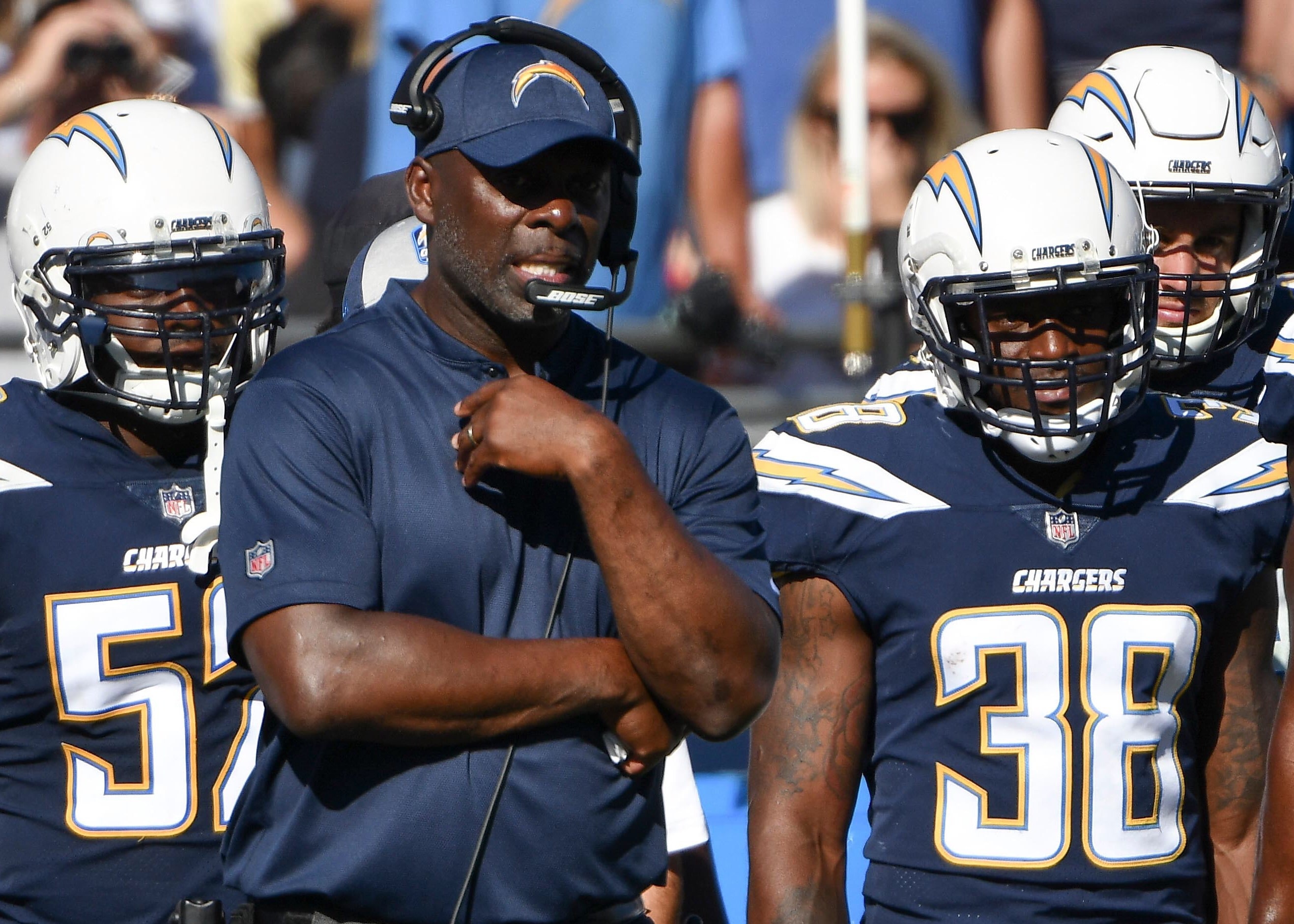
The struggle for Chargers coach Anthony Lynn is grappling with how poorly the number of black NFL coaches reflects on the percentage of black players. (Robert Hanashiro/USA TODAY Sports)
Some minority advocates are unconcerned with missing out on the McVay Wave.
Miami running backs coach Eric Studesville is black. He has been an NFL assistant for 22 years. He served four games as Denver’s interim head coach in 2010.
He explained he doesn’t fret too much. He has seen too many flavors of the year come and go.
“For years it was Bill Walsh’s guys. Then it was Mike Shanahan’s guys,” Studesville said. “There are trends, it seems, and now it’s the Sean McVays or whatever that is. It goes in spurts.”
Lynn reasoned the number of black NFL head coaches accurately reflects the percentage of America’s population. Then he reflected on how poorly the number reflected on the percentage of black players.
“That’s the struggle to me, having a hard time getting into this (coaching) business after all they’ve given to the business,” Lynn said. “I try to help former players — white, black, brown — get into coaching as much as I can. They have an insight about this game some people never are going to have.
“We’re still fighting for equal opportunity, every profession in this world. The NFL is nothing new. It’s society. It’s definitely improving. It’s getting better, but we still have work to do.”
The Athletic Miami’s Chris Perkins contributed to this report.
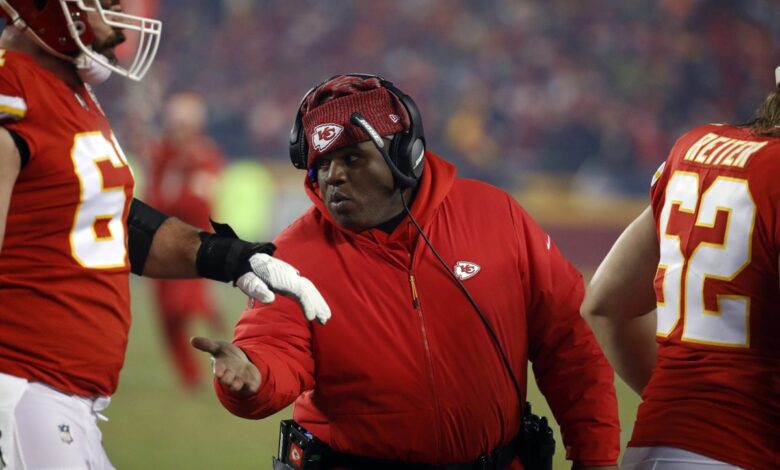
(Top photo of Kansas City Chiefs offensive coordinator Eric Bieniemy: Charlie Riedel/AP)
Source link


