Bears Beat Seahawks 34–17 by Turning a New Addition Into a Team-Wide Answer
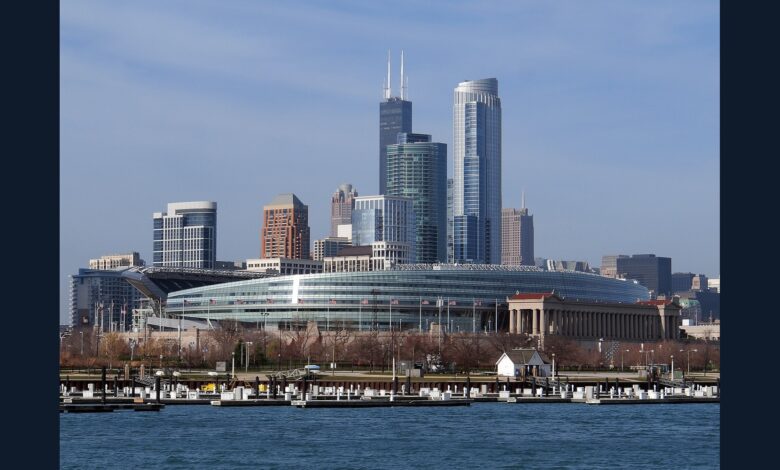
Archival and illustrative photograph: Soldier Field and the Chicago skyline on November 25, 2011. Photo by John Picken via Wikimedia Commons. Licensed CC BY 2.0. Shown in a full-frame presentation with neutral borders added by HuddleUp to preserve the complete original composition; no image content was removed. This archival stadium photograph does not depict the November 2, 2026 game in Seattle, the players or any current-event action.
Event/update date: November 2, 2026
The Chicago Bears did more than introduce Jeffery Simmons on Monday night. They showed how quickly a major addition can matter when the rest of the roster keeps doing its own work.
Chicago beat the Seattle Seahawks 34-17 on November 2 at Lumen Field, improving to 6-2 with a third consecutive victory. The result was built across all three phases: Caleb Williams moved the offense against the league’s top-ranked defense, D’Andre Swift scored three rushing touchdowns, and Chicago’s defense repeatedly ended Seattle possessions before they developed.
A long opening drive set the standard
The Bears forced a three-and-out on Seattle’s first possession, then answered with a 17-play, 80-yard touchdown drive. Williams completed a short scoring pass to Luther Burden III to finish it. NFL Research, cited by the league’s game analysis, said it was the longest touchdown drive by play count against Seattle in ten years.
That drive mattered because it required patience. Chicago did not begin the night by demanding a highlight from its newest star or a quick strike from its quarterback. It stayed organized for 17 plays in one of the league’s loudest road environments.
Williams finished 24 of 34 for 247 yards, one touchdown and no interceptions. The Bears’ official recap credited Rome Odunze with 87 receiving yards, Colston Loveland with 65 and Burden with 56. That distribution made it harder for Seattle to reduce the offense to one matchup.
Simmons changed the front without becoming the whole story
Chicago acquired Simmons from Tennessee only days before the game. In his Bears debut, he recorded six tackles, a sack, two tackles for loss and a pass defended, according to the Bears and NBC Sports.
The numbers justify attention, but they also reveal why the performance should not be framed as a one-man rescue. Montez Sweat produced a sack and three quarterback hits. Austin Booker contributed a field-goal block and later deflected the pass that James Lynch intercepted. The defense held Seattle to 252 total yards and one conversion on 11 third downs.
Analysis: The most encouraging leadership signal was not that Simmons arrived ready to dominate every snap. It was that Chicago could give him a defined role inside an existing structure. Successful integration lets a new player add force without requiring teammates to wait for him to solve every problem.
Chicago answered when the game tightened
The Bears led 20-9 before Seattle turned a Loveland fumble into a touchdown and two-point conversion, cutting the margin to three. That was the point when a strong night could have become a lesson in lost control.
Instead, Chicago scored the final 14 points. A delay-of-game penalty erased what appeared to be a Seattle third-down stop; on the next snap, Kalif Raymond took a short pass 39 yards to the Seahawks’ 5. Swift scored two plays later. Lynch’s interception then gave the offense another short field, and Swift’s third touchdown closed the scoring.
Swift’s 69 rushing yards on 27 carries were not a high-efficiency rushing total, but his three touchdowns reflected the offense’s willingness to keep a dependable plan near the goal line. Chicago also converted seven of 15 third downs against a defense that had allowed very little sustained movement this season.
Seattle’s response offered the clearest measure
The Seahawks’ official review did not hide behind one controversial call or one turnover. Seattle acknowledged problems on offense, defense and special teams. The offense went one for 11 on third down. The defense allowed 363 yards and three extended touchdown drives. Special teams included a missed extra point, a blocked field goal and costly penalties.
That full accounting is important because Chicago’s win should not be reduced to the Simmons trade. The Bears did benefit from their newest defender, but they also controlled long stretches through protection, route distribution, tackling, pressure and situational execution.
The result places Chicago at 6-2 and sends Seattle to 4-4 after the defending champions lost for the third time in four games. Standings create the headline pressure, but the more durable lesson is organizational: a new player becomes most valuable when he strengthens a team’s identity rather than replacing it.
Chicago’s next challenge is to prove that this was not only the emotional lift of a major debut. The standard from Seattle was shared responsibility. If the Bears keep that structure, Simmons’ arrival can become more than a one-night spark.
Sources
- Chicago Bears: game recap and official statistics
- NFL: Bears-Seahawks Monday Night Football analysis
- Seattle Seahawks: official rapid reactions
- NBC Sports: independent game report
Join the Huddle for email updates.
Explore HuddleUp Magazine’s published NFL coverage portfolio. This desk report is continuing coverage and is not presented as on-site Media Week reporting.
Newsroom transparency: This AI-assisted desk report was produced from the linked public sources and edited for accuracy and context. HuddleUp did not conduct an on-site interview. Read our Editorial Standards & Transparency.