Derwin James Jr. Moves to Injured Reserve After a Rehab Setback, Testing the Chargers’ Patience
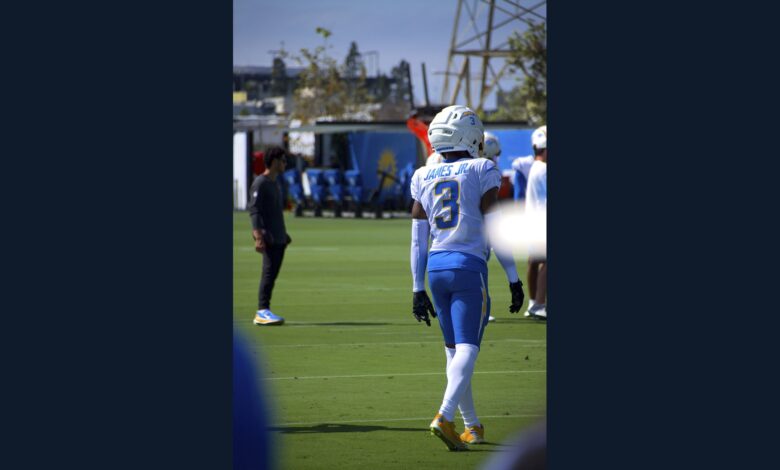
Archival and illustrative photograph: Derwin James Jr. at Los Angeles Chargers training camp on August 16, 2026. Photo by Sterling Dee via Wikimedia Commons. Licensed CC BY 4.0. Shown in a full-frame presentation with neutral borders added by HuddleUp to preserve the complete original composition; no image content was removed. This archival training-camp photograph predates the reported rehab setback and does not depict the October 31 injured-reserve transaction.
Event/update date: October 31, 2026
The Los Angeles Chargers placed safety Derwin James Jr. on injured reserve on October 31, formalizing a longer pause after a hamstring rehabilitation setback. In a winless season, the transaction asks the organization to protect patience when competitive urgency is loudest.
The Chargers announced the move and signed cornerback Isas Waxter to the active roster. They also elevated cornerback Kaiir Elam from the practice squad for the November 1 game against the Rams. The NFL transaction list records James’ move to Reserve/Injured on the same date.
The setback changed the return timeline
Associated Press reporting said James has not played since Los Angeles’ September 27 loss at Buffalo. Coach Jim Harbaugh had disclosed during the week that the veteran safety experienced a setback in rehabilitation and recovery. Injured reserve requires James to miss at least four games.
That sequence is more important than any attempt to predict an exact return. The public record establishes an extended absence, a setback and a roster designation. It does not establish that James will be ready immediately when the minimum four-game period ends, and HuddleUp is not making that inference.
A rehab setback is not evidence of poor effort. Recovery is not a straight line, especially for a position that demands sudden acceleration, deceleration and open-field change of direction. A safety can feel improvement during controlled work and still discover that the tissue is not ready for the volume or intensity of game preparation.
Winless pressure cannot define medical judgment
The Chargers entered the Rams matchup 0-6. That record creates understandable pressure on every coach and player, but it should not turn availability into a character test. James’ leadership value does not depend on ignoring the information provided by his body or the medical staff.
Analysis: The strongest organizational response is to separate competitive urgency from return-to-play decisions. Los Angeles can urgently improve communication, tackling and role clarity. It cannot responsibly compress biology to match the standings. Placing James on injured reserve makes that boundary visible.
Harbaugh’s staff must also avoid framing the transaction as simply losing a star. The move changes responsibilities for the players who remain. The Chargers’ corresponding personnel decisions added secondary options, but roster depth only becomes functional when coaches define who communicates, who handles matchup adjustments and how the defense replaces James’ versatility.
Leadership continues when a player is unavailable
James is a Pro Bowl safety and one of the most recognizable defenders on the roster. His absence removes a player who can align in multiple areas and help organize teammates before the snap. The Chargers now have to decide which parts of his role can be distributed and which should be simplified.
That challenge also creates a leadership opportunity for James, provided the organization and medical plan allow it. An injured veteran can contribute through film preparation, sideline communication and support for the players assuming new responsibilities. None of those contributions should be used to pressure him toward an early return.
The same principle applies to teammates. Replacement players should not be asked to imitate James play for play. They need assignments built around their actual strengths. Coaches should measure success through fewer communication breakdowns, reliable tackling and disciplined leverage, not through whether one player recreates a Pro Bowl résumé.
The transaction gives the Chargers a clearer planning window
Injured reserve removes weekly speculation for at least four games. That clarity can help the medical staff manage a more deliberate progression and help the defensive staff prepare without building a plan around a questionable late-week return.
The roster move does not answer every question. Los Angeles has not publicly announced a return date, and a minimum absence is not a guarantee. The responsible milestones will be functional: tolerance for repeated high-speed work, confidence in movement, full practice participation and recovery after each increase in workload.
James’ setback arrives during a season already testing organizational patience. The Chargers’ response will show whether patience is treated as passivity or as disciplined leadership. A careful plan can still be urgent about standards, preparation and communication while refusing to make one player’s health the shortcut to a turnaround.
The injured-reserve designation is disappointing for the player and the team. It is also a chance to demonstrate that football toughness includes accepting a setback, rebuilding capacity and returning only when the work supports it.
Sources
- Los Angeles Chargers: Derwin James Jr. placed on Reserve/Injured
- Associated Press: James placed on IR after hamstring rehab setback
- NFL: October 31 reserve-list transactions
Join the Huddle for email updates.
Explore HuddleUp Magazine’s published NFL coverage portfolio. This desk report is continuing coverage and is not presented as on-site Media Week reporting.
Newsroom transparency: This AI-assisted desk report was produced from the linked public sources and edited for accuracy and context. HuddleUp did not conduct an on-site interview. Read our Editorial Standards & Transparency.