Bears Beat Lions 39–35 by Holding Their Nerve Until the Final Three Seconds

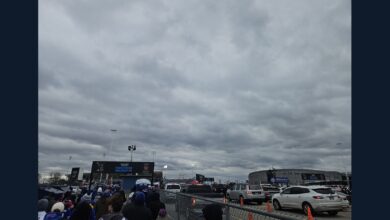
Archival and illustrative photograph: the exterior of Ford Field in Detroit on December 25, 2025. Credit: Michael Barera; source: Wikimedia Commons. Rights: CC BY-SA 4.0. Shown in a full-frame presentation with neutral borders added by HuddleUp to preserve the complete original composition; no image content was removed. This archival stadium photograph does not depict the November 26, 2026 Bears–Lions game, its players or the final touchdown.
Event/update date: November 26, 2026
The Chicago Bears beat the Detroit Lions 39–35 on Thanksgiving after Caleb Williams found Rome Odunze for a six-yard touchdown with three seconds remaining. It was Chicago’s first lead of the game and the final turn in an afternoon that repeatedly appeared to belong to Detroit.
The Bears improved to 9–2, won their sixth consecutive game and moved into first place in the NFC North. Detroit fell to 8–3 and lost at Ford Field for the first time this season.
Chicago stayed connected while the score moved away
Detroit led for 53 minutes and 31 seconds, according to the NFL’s postgame analysis. Jahmyr Gibbs ran for 205 yards and three touchdowns, including a 70-yard score that put the Lions ahead 35–24 with 8:20 remaining. The home team finished with 549 yards of offense.
Those numbers usually describe a decisive win. Chicago’s response was to keep the game within the reach of one possession at a time. Williams and Odunze connected for touchdowns twice in the final 7:20. The first narrowed the deficit. The second completed the comeback.
Analysis: Composure is not pretending the game is going well. It is maintaining enough clarity to correct what is failing while continuing to execute the next assignment. Chicago’s defense had been stressed all afternoon, but the Bears still produced the fourth-down stop that gave their offense one final opportunity.
The final drive required trust and precision
Chicago took over at its own 32-yard line after Detroit failed on fourth-and-four with just over two minutes remaining. The Bears converted a fourth-and-one during the drive, then moved to the Detroit six-yard line.
On third-and-goal, Williams placed the ball toward the back corner of the end zone. Odunze kept his feet in bounds and secured the catch. The throw needed accuracy, the receiver needed body control and the offense needed the confidence to attack the matchup with the season’s division lead at stake.
Williams finished 30 of 44 for 345 yards, two touchdowns and no interceptions. Odunze caught six passes for 87 yards, with both touchdowns arriving late. The production mattered, but the timing revealed the larger leadership lesson: trust built during ordinary repetitions becomes most valuable when there is no room for another mistake.
Detroit’s excellence did not erase its finishing decisions
The Lions produced several winning-level performances. Gibbs added 48 receiving yards for 253 yards from scrimmage. Amon-Ra St. Brown caught seven passes for 146 yards. Jared Goff completed 25 of 36 passes for 313 yards and a touchdown. Rookie edge rusher Derrick Moore recorded two sacks and forced two fumbles.
Yet Detroit had two late chances to close the game. A fourth-quarter interception of Goff ended one possession. Later, the Lions kept the offense on the field for fourth-and-four at the Chicago 33. Goff’s short pass to Gibbs gained one yard after linebacker T.J. Edwards made the tackle.
The decision can be evaluated without reducing the loss to one call. Detroit’s identity includes aggression, and that approach has produced important wins. Leadership requires the same standard after a failure: explain the reasoning, study the execution and decide whether the process still fits the situation.
A division lead increases the standard
The Bears allowed 549 yards, 205 rushing yards to one player and repeated explosive plays. A last-second victory does not make those weaknesses disappear. It gives Chicago the opportunity to address them from first place rather than from regret.
Detroit also has useful evidence. Its offense moved the ball against a strong rival, its young defenders created impact plays and the team controlled most of the afternoon. The loss becomes damaging only if the Lions protect the disappointment from honest review.
The NFC North race did not end on Thanksgiving. Chicago now holds the immediate advantage, while Detroit must respond after its six-game winning streak ended. Both teams have enough evidence to believe they can contend and enough flaws to demand urgency.
The finish belongs to more than one play
Odunze’s catch will define the highlight. It should. The moment required elite execution with three seconds left. But Chicago reached that play because the offense answered an 11-point deficit, the defense made a fourth-down stop and the team avoided emotional collapse while Detroit controlled the game.
That is the useful meaning of resilience in football. It is not a slogan applied after a dramatic win. It is a chain of disciplined actions that keeps a team capable of winning before the final opportunity arrives.
Chicago did not need to lead for most of Thanksgiving. It needed to remain organized long enough to lead when the clock reached three seconds. The Bears met that test, and the division standings now reflect it.
Sources
- Detroit Lions: official game recap
- NFL: Thanksgiving tripleheader analysis
- Associated Press: Williams and Odunze deliver the winning score
- Reuters: Chicago takes control of the NFC North
- NFL: official Week 12 scores
Join the Huddle for email updates.
Explore HuddleUp Magazine’s published NFL coverage portfolio. This desk report is continuing coverage and is not presented as on-site Media Week reporting.
Newsroom transparency: This AI-assisted desk report was produced from the linked public sources and edited for accuracy and context. HuddleUp did not conduct an on-site interview. Read our Editorial Standards & Transparency.