Panthers’ Defensive Shake-Up Tests Whether Urgency Can Produce Accountability
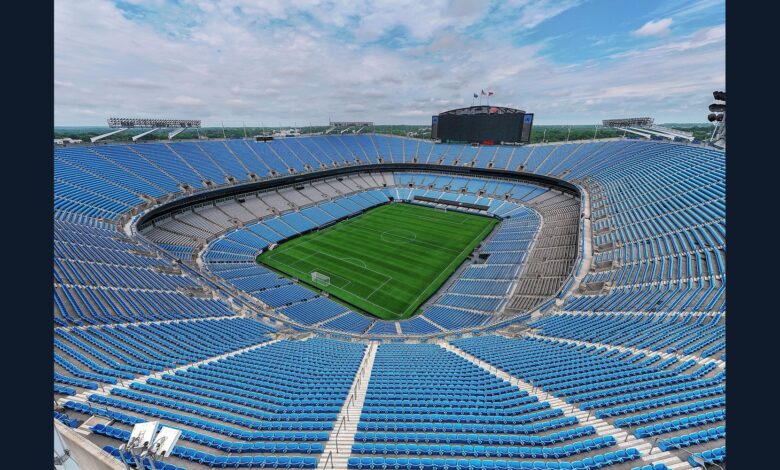
Archival and illustrative photograph: Bank of America Stadium in Charlotte on July 31, 2025. Photo by Quintin Soloviev via Wikimedia Commons. Licensed CC BY 4.0. Shown in a full-frame presentation with neutral borders added by HuddleUp to preserve the complete original composition; no image content was removed. This archival stadium photograph does not depict the October 2026 coaching changes, the dismissed coaches or a current game.
Event/update date: October 30, 2026
The Carolina Panthers changed defensive leadership less than a day after losing 27-19 at Green Bay. The organization now has ten regular-season games to prove that a midseason firing can create clearer responsibility instead of merely moving pressure from one coach to another.
Carolina announced October 30 that it had parted ways with defensive coordinator Ejiro Evero and defensive passing game coordinator Jonathan Cooley. Defensive line coach Todd Wash became interim coordinator and will call the defensive plays. Outside linebackers coach and run-game specialist AC Carter will add the defensive line to his responsibilities, while Renaldo Hill continues overseeing the secondary.
The move followed a specific defensive problem
Associated Press reporting placed the decision in the context of Carolina’s 3-4 start. The Panthers entered the week ranked 22nd in total defense and last against the run. The Green Bay loss brought urgency to a problem that had become difficult to describe as temporary.
The Panthers’ own announcement emphasized Wash’s experience. He has worked in the NFL for two decades and previously spent five seasons as Jacksonville’s defensive coordinator. His 2017 Jaguars defense ranked second in the league and reached the AFC Championship Game.
Experience, however, is not a midseason solution by itself. Wash inherits the same players, recent injuries and limited practice time. His first responsibility is to make assignments and communication clearer without asking the defense to learn an entirely new identity during the season.
Dave Canales now owns the decision
AP reported that head coach Dave Canales consulted owner David Tepper, general manager Dan Morgan and executive vice president Brandt Tilis but described the final choice as his. That detail matters because leadership becomes measurable when authority and responsibility stay connected.
Firing a coordinator can signal standards. It can also become a shortcut if the organization treats one person as the complete explanation for a unit’s performance. Carolina’s defense has been affected by injuries in the secondary, while the run-defense ranking points to issues that involve personnel, technique, tackling and scheme.
Analysis: Canales’ decision raises the standard for the entire football operation, not only for Wash. The head coach must define what will change. Position coaches must translate that direction. Players must improve execution. The front office must evaluate whether the roster gives coaches enough options. If those responsibilities remain vague, the dismissal will produce motion without producing accountability.
Interim leadership requires simplification
Wash’s immediate task is less about invention than prioritization. A struggling unit usually benefits from fewer uncertain checks, stronger alignment against the run and clear answers when an opponent changes formations. The best midseason adjustments reduce hesitation while preserving enough flexibility to avoid becoming predictable.
Carolina also has to manage workload. Moving Carter onto the defensive line broadens his responsibilities at the same moment the staff is trying to stabilize performance. That can work if roles are defined precisely; it can create new gaps if the organization assumes experienced coaches can simply absorb unlimited duties.
The next opponent will offer an early test, but one game should not be treated as a verdict. Improvement should be tracked through repeatable indicators: early-down run defense, missed tackles, explosive plays allowed, third-down communication and whether the defense can get off the field without relying on takeaways.
The players’ response will matter as much as the new call sheet. A coaching change can sharpen attention for a week, but sustainable improvement requires veterans to reinforce standards when a practice rep breaks down or a game begins to tilt. Younger players also need consistent language from every position room. If the staff change produces competing messages, Carolina could lose the clarity it is trying to create. If it produces one shared defensive vocabulary, the Panthers will have at least established a foundation for fair evaluation.
The final evaluation belongs to the organization
Evero is the first NFL coordinator reported fired during the 2026 season. That fact makes the move visible, but visibility should not be confused with effectiveness. Carolina’s decision will deserve credit only if the new structure helps players perform more consistently and gives the organization better information for its offseason decisions.
The Panthers have chosen urgency. The remaining schedule will show whether urgency becomes a disciplined plan or merely a public response to frustration. Accountability is not completed when a coach is dismissed; it begins when the people who remain explain what they will do differently and accept evaluation against that standard.
Sources
- Carolina Panthers: defensive coaching staff changes
- Carolina Panthers: Dave Canales explains urgency
- Associated Press: Panthers fire Ejiro Evero after Packers loss
Join the Huddle for email updates.
Explore HuddleUp Magazine’s published NFL coverage portfolio. This desk report is continuing coverage and is not presented as on-site Media Week reporting.
Newsroom transparency: This AI-assisted desk report was produced from the linked public sources and edited for accuracy and context. HuddleUp did not conduct an on-site interview. Read our Editorial Standards & Transparency.